The Colorado Verification Protocol
A trusted identity layer for rental housing. Verifies renter documentation, standardizes submissions, and enables property operators to process applicants with consistency and compliance.
Why Colorado Established This Verification Protocol
Colorado’s rental ecosystem historically lacked a shared, trusted identity layer. Each property required different documents, applied inconsistent verification processes, and relied on data that could not be reliably compared or validated.
Renters were forced to recreate their identity at every application. Landlords evaluated applicants without a standardized foundation for decision-making.
The Colorado Verification Protocol resolves this by establishing a uniform, secure statewide verification layer that governs how documentation is validated and exchanged across the entire rental sector.
How the Colorado Verification Protocol Operates
The Protocol issues the Colorado Passport, a standardized verification bundle containing validated documentation used across rental housing workflows.
Renters complete a single verification process. Landlords receive consistent, structured information in a trusted format. Students and first-time renters use the same statewide method.
The Protocol defines the required inputs, verification standards, visibility permissions, and transfer rules that govern how information is validated and exchanged between renters and property operators.
Select Your Protocol Interface
Access the implementation of the Protocol that corresponds to your role in the rental ecosystem.
Governance & Compliance Framework
The Colorado Verification Protocol aligns with Colorado housing statutes, documentation standards, and verification best practices. All verification data is handled under standardized protocol guidelines for accuracy, privacy, and controlled access.
These guidelines define how verification inputs are validated, how long they may be relied upon, and the conditions under which data can be transmitted to property operators. Protocol rules govern access, retention, and use to maintain a consistent statewide framework.
Access the Colorado Verification Protocol
Select the interface corresponding to your role in the rental ecosystem.
A trusted identity layer supporting secure and consistent applicant evaluation.
For Landlords & Property Managers
Colorado’s Standard for Renter Verification
Instant, protocol-verified clarity on applicant identity, income eligibility, and rental reliability indicators — the statewide system engineered to eliminate uncertainty and accelerate approvals.
Already Have an Applicant?
Issue a Protocol Invitation in under 60 seconds.
No landlord fees. No document chasing. Instant statewide compliance.
Stop Screening. Start Selecting.
Recruit from a competition-ready pool of verified renters.
The Colorado Verification Protocol doesn’t just verify renters — it changes how they behave. Renters build a Colorado Passport to stand out, not just to get in the door. This shifts your role from a defensive screener to a proactive selector with a curated, competition-ready pool of applicants.
Renters compete on reliability — not speed.
Applicants with a Passport have already proven income, stability, and rental history. They're not racing to “apply first.” They're competing to be the best-qualified option.
You receive a synchronized cohort, not a chaotic queue.
Instead of random, unknown applicants, you get a structured cohort of credentialed renters using standardized statewide performance signals.
The Protocol silently filters for you.
Unstable, unverifiable, or non-compliant applicants are filtered out before they reach you. You don’t spend time rejecting — only choosing.
Passport Preferred listings rise to the top.
Marking your unit as Passport Preferred signals professionalism and attracts a tier of renters who value stability and long-term reliability.
The Old Way
“Who applied first?”
The Protocol Way
“Who has proven they’re the right fit?”
The Protocol is becoming Colorado’s standard for rental verification.
By marking your listing as Passport Preferred, you’re not just optimizing screening — you’re aligning with where the market is going.
Begin receiving verified applicant cohorts.
“I don’t manually screen tenants anymore — the Protocol does. I choose from a shortlist.”
— Portfolio Manager, Boulder
What You See as a Landlord
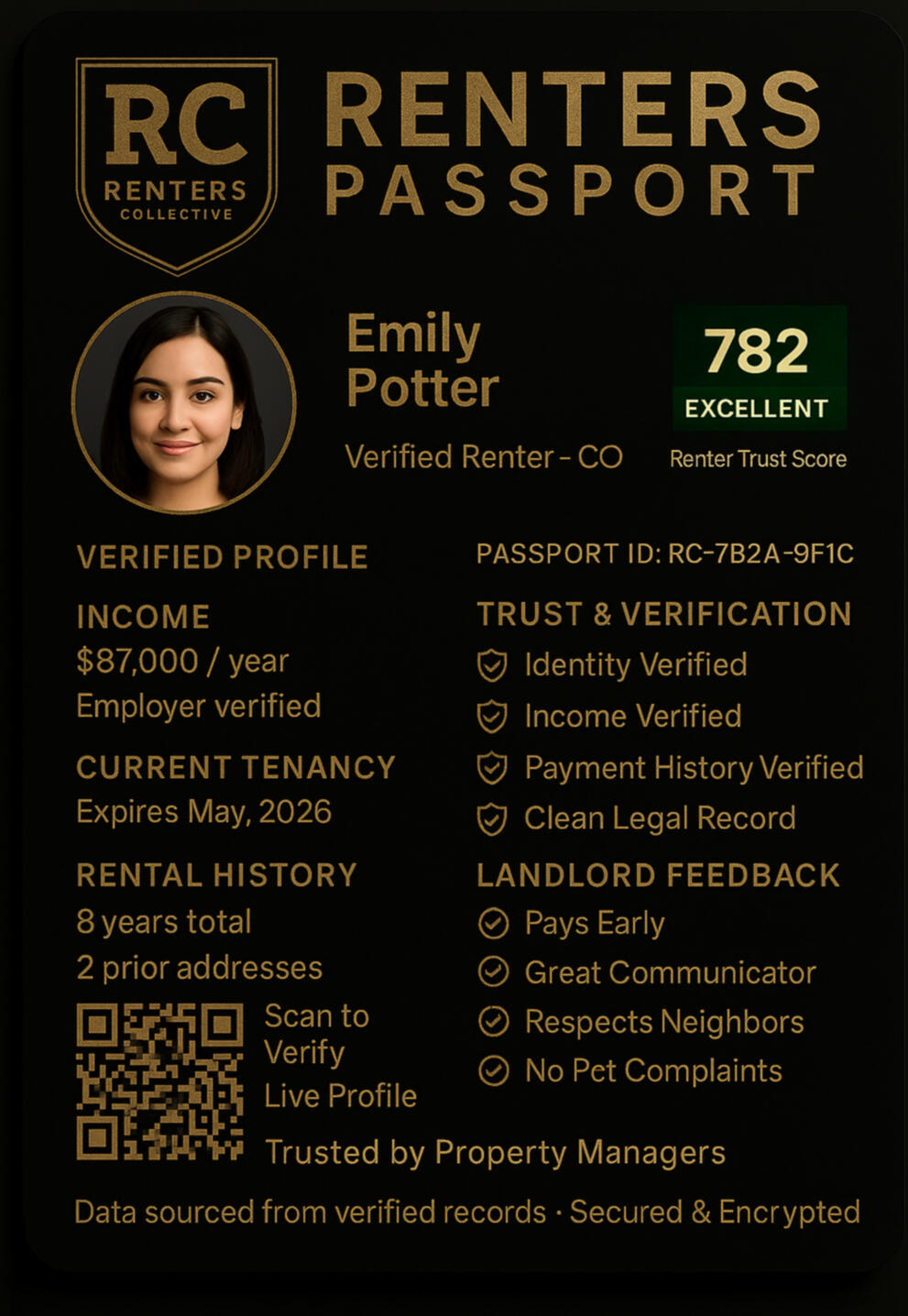
Each completed Colorado Verification Protocol generates a standardized, decision-ready set of deliverables. These materials eliminate guesswork and create a unified screening language across Colorado housing providers.
Verification Packet
Verified identity, cross-property rental performance, eligibility analysis, and structured reliability metrics.

Renter Passport
A reusable statewide credential containing verified identity, income qualification, compliance history, and Discovery readiness.
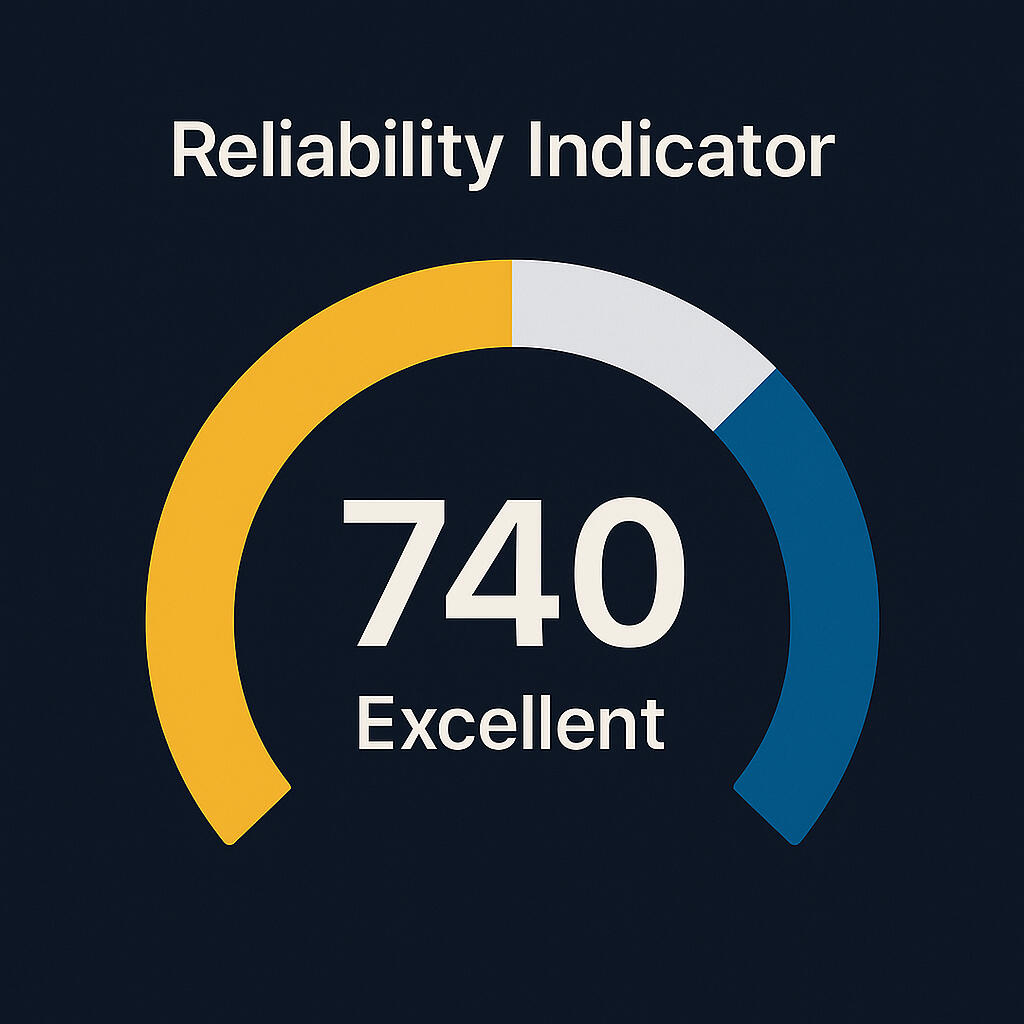
Reliability Indicators
Forward-looking stability, stewardship, and affordability indicators derived from structured, independently verified data.
Landlord Use Boundary
What you can and cannot do with verification data
This boundary protects renters, landlords, and the protocol itself. When using the Colorado Verification Protocol, you agree to use Passport data solely for rental screening decisions on the specific application in front of you.
Allowed
- Use Passport data to approve or deny a rental application.
- Confirm identity, income, and rental history for this property.
- Request updated verification when reapplying.
Not Allowed
- Selling or re-using Passport data outside your own rentals.
- Using Passport data for employment, credit, or non-housing decisions.
- Storing screenshots beyond normal record-keeping policy.
Enforcement
- Misuse may result in suspension of protocol access.
- Severe abuse may be referred to legal counsel or regulators.
- Renters may report suspected misuse directly.
Quick landlord FAQ
Can I use one Passport for multiple properties?
Yes — if you are the landlord or manager and the renter is actively applying with you. Do not forward the Passport to third parties.
Can I download and keep a copy forever?
Copies must follow your normal rental records policy. Bulk export or resale is not permitted.
Can I deny someone based only on verification?
No — the Passport is only one input. You must still follow all fair-housing and Colorado landlord-tenant laws.
How do renters know this boundary exists?
Renters see the same boundary in their Passport interface and onboarding materials.
Screen Your First Applicant
Under the Protocol
Submit a property and applicant, and we will issue a Colorado Protocol Invitation on your behalf. The renter completes verification and pays the identity verification fee; you receive a standardized, decision-ready outcome without ever handling raw sensitive data.
- • No landlord fees or subscription requirements.
- • We deliver the Protocol Invitation to your applicant.
- • Renter pays the verification fee directly.
- • You receive a decision-ready, statewide-standard Protocol result.
Use this workflow for individual applicants or to pilot the Protocol across your portfolio.
Request a Protocol Invitation
Enter basic information about your property and applicant. We’ll follow up with a secure Protocol Invitation link that you can share with your renter to begin verification.
Request Applicant Verification → This button directs landlords into the onboarding workflow. You may swap in a dedicated property/applicant intake system later.See what a complete Colorado Passport looks like when shared with a housing provider.
Bulk Protocol Invitations
Send standardized Protocol Invitations across multiple applicants and units to streamline verification workflows for your entire portfolio.
Portfolio Reporting
Access structured verification outcomes across all units to improve decision consistency, compliance, and property-level audit readiness.
Compliance Records
Maintain standardized, timestamped Protocol verification results to ensure consistent screening decisions and support regulatory accountability.
How the Protocol Works for Landlords
This is a governed screening workflow. You issue a Protocol Invitation, the renter uses or activates their Colorado Passport, and you receive a standardized verification outcome without ever handling raw sensitive data.
You send the applicant a secure Protocol Invitation instead of requesting uploads or PDFs. The invitation routes them to the Protocol, not to your email or devices.
You define screening criteria and timing. The invitation never requests SSNs, banking info, or raw documents.
The applicant connects an existing Passport or activates one. Verification occurs through Protocol standards to prepare a share-ready result.
Renter pays the verification fee unless they have an active Passport already.
Once authorized, you receive a structured Protocol result: verification tier, timelines, eligibility indicators, and flags — all under statewide rules.
Sensitive data remains inside the Protocol; you see only what you need.
Use the Protocol outcome and your own criteria. The Protocol stores the verification record for consistent, auditable decision-making.
Your reference is the Protocol ID — not screenshots or informal notes.
Observed Use Within Colorado Housing Workflows
Documentation reflecting recorded utilization across rental verification processes.
Record Period: Most recent 12-month operational cycle
Colorado Multi-Family Portfolio Operators
Recorded utilization within Front Range and metro portfolio workflows.
Affordable Housing Providers
Screening consistency observed across income-qualified housing pathways.
Independent Rental Owners
Documented adoption by small-portfolio landlords and individual property owners.
Start With Your First Protocol Invitation
Issue your first screening request under the Colorado Verification Protocol. No landlord fees. No document handling. Fully standardized.
Start Verification →No landlord fees. Applicants pay the standard Protocol verification fee.
Why the Protocol Is Different
The Colorado Verification Protocol replaces fragmented screening tools with a unified statewide system that evaluates renters using verified identity data, standardized reliability indicators, and consistent cross-property performance signals.
Standardized Verification
Every Passport follows the same statewide criteria, eliminating inconsistent screening practices.
Verified Identity Data
Identity, income, enrollment, and rental history are fully verified — no raw documents, no guesswork.
Reliability Indicators
Standardized, forward-looking indicators derived from independently verified data.
Cross-Property Signals
The Protocol aggregates performance consistently across properties to surface verified patterns.
Privacy-Preserving by Design
Landlords never handle documents or sensitive data — all sharing is renter-authorized.
Governance & Auditability
Every verification is logged and auditable. Decisions are fair, defensible, and consistent.
Operational Risk Reduction
The Protocol reduces tenancy instability by aligning verified renter behavior with your property's long-term requirements. Better matches mean fewer turnovers, lower vacancy loss, and more predictable rental income.
View the Full Pricing Schedule
Review the complete statewide fee structure, including renter verification fees, optional activation services, and portfolio agreements.
Go to Pricing Page →Questions Landlords Commonly Ask
How long does verification take?
Most renters complete their Protocol inputs within 24 hours. Results are generated as soon as identity, income, and rental performance data are verified through secure partners.
What exactly will I receive?
You receive the standardized Verification Packet, the Renter Passport, and the Protocol’s Reliability Indicators — all delivered in a consistent statewide format.
Do I receive documents?
Yes. Verified documents and data sources are included in the Protocol Packet once the applicant completes identity and eligibility verification.
Who pays the verification fee?
Renters pay the identity verification fee. Landlords only pay when initiating a Protocol verification themselves.
What if the renter doesn’t finish?
You’ll be notified automatically. No fees apply unless the verification is completed and a Protocol result is issued.
Is this legally compliant?
Yes. The Protocol aligns with Colorado rental regulations and standard screening requirements. Identity, income, and rental history are validated through compliant data sources.
Does this replace credit or background checks?
No. The Protocol verifies identity and rental performance. You may obtain credit or criminal background reports as required by your internal screening policies.
Do renters see my information?
No. Visibility only flows from renter to landlord. Renters never see your contact information, notes, or internal criteria.
How do Protocol Invitations work?
You provide basic applicant details. The renter receives a secure Protocol Invitation and completes verification. You receive a unified, decision-ready outcome.
What is Discovery State?
Discovery determines whether verified renters are visible to eligible housing providers. No identifying information is shared unless the renter chooses to share their Passport with you.
Can renters reuse their Passport?
Yes. Once verified, renters may reuse their Passport for any participating property in Colorado.
Protocol Support for Landlords
Our support team can assist with verification workflows, Protocol Invitations, compliance-related questions, and technical issues. We typically respond within one business day.
Email Protocol Support →If your email app doesn’t open, contact us at: [email protected]
How Protocol Invitations Work
Understand how landlords initiate verification without handling raw documents.
Verification Tiers Explained
Learn how standardized verification tiers improve fairness and clarity.
Reliability Indicators Guide
Explore how stability, consistency, and affordability signals are derived.
Compliance & Privacy Overview
Review Protocol privacy protections, statewide standards, and compliance foundations.
How Protocol Invitations Work
Protocol Invitations allow housing providers to initiate verification without handling raw documents. Each invitation is tied to a specific property and applicant, ensuring accuracy and compliance.
- • Invitations are generated under a consistent statewide format.
- • The renter authorizes verification using their Passport or activates one.
- • The landlord never handles sensitive data or uploaded files.
- • All verification flows through the Colorado Verification Protocol.
- • Results are delivered in a standardized, decision-ready format.
Verification Tiers Explained
Verification tiers provide a standardized interpretation of an applicant’s documentation, rental history, and reliability signals under the Protocol’s defined rules.
- • Tier criteria are consistent across all Colorado housing providers.
- • Tiers remove ambiguity and eliminate subjective scoring variations.
- • Each tier reflects verified data, not self-reported claims.
- • Tier output integrates directly with Protocol decision guidelines.
Reliability Indicators Guide
Reliability Indicators provide structured insights into applicant stability, rental performance, affordability, and property stewardship—derived exclusively from verified data.
- • Indicators reflect patterns in verified rental performance.
- • Signals highlight stability, predictability, and consistency.
- • Indicators are standardized across regions and properties.
- • No raw data is shared with landlords—only structured outcomes.
Compliance & Privacy Overview
The Protocol is built on secure, privacy-preserving data handling frameworks. Applicants control data sharing, and no raw documents are ever transmitted to landlords.
- • All access is logged and auditable.
- • Sensitive data is never emailed or shared directly.
- • Protocol verification complies with statewide housing guidelines.
- • Applicants retain complete control over data visibility.
All verification outcomes are issued under Section 3.1 of the Colorado Verification Protocol. Standardized criteria. Statewide consistency. Zero raw-document handling.
A trusted identity layer supporting secure and consistent applicant evaluation.
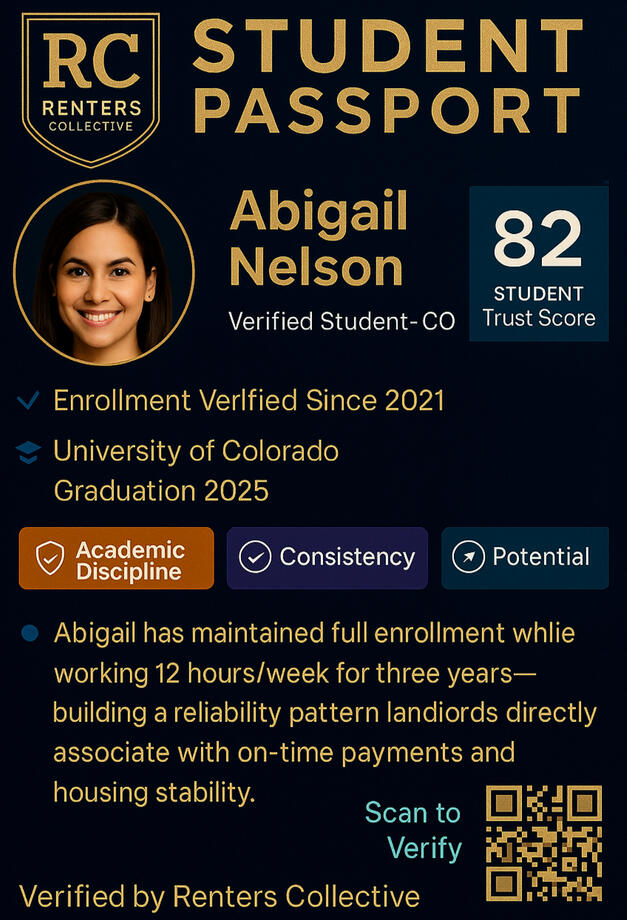
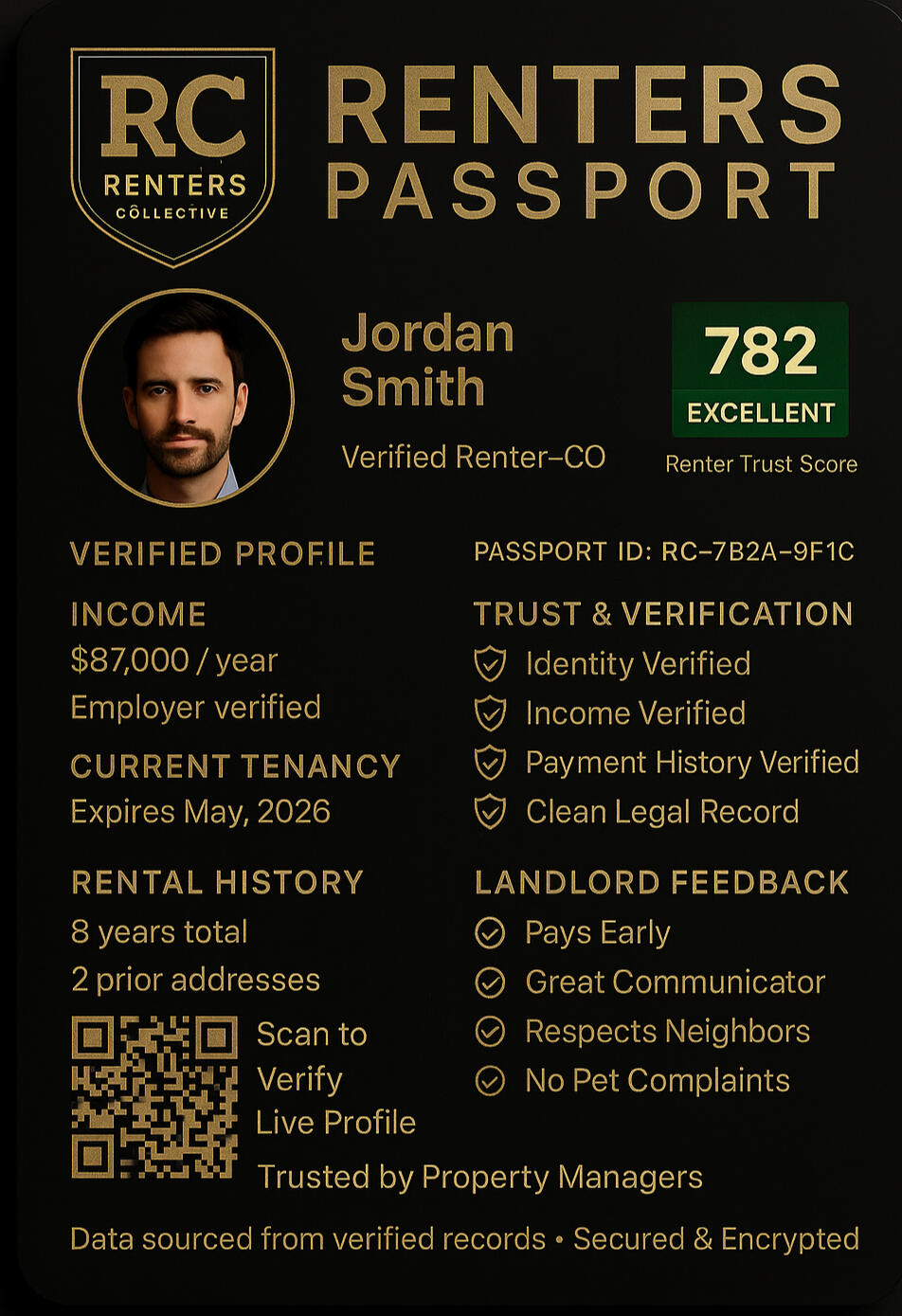
All credentials follow identical verification standards and privacy limits.
No additions, modifications, or external documents permitted.
Protocol Fee Structure
Fees apply only when a verification session is completed. Renters are not charged unless optional activation services are selected.
Landlord Verification Fee
$29
Charged only after a completed Protocol verification. No minimums, subscriptions, or fees for incomplete sessions.
Renter Costs
$0
Verification is always free for renters. Activation services are optional and billed only when selected.
Portfolio / Institutional
Custom Agreements
Structured reporting, integrations, and operational alignment for large housing providers and statewide portfolios.
The Protocol applies fees only when a verification session is successfully completed. Landlords are billed only after receiving a finalized, decision-ready Protocol result.
Renters are never charged unless they choose optional activation services. This structure ensures equitable access, transparency, and predictable screening costs for all parties.
A trusted identity layer supporting secure and consistent applicant evaluation.
Colorado Verification Protocol
Technical Specification – Version 1.0
Protocol Identifier: CVP-1.0
Release Date: 2026-01-15
Effective Date: 2026-02-01
Status: ACTIVE
Governing Authority: Colorado Housing Statutes
Administrative Authority: Colorado Verification Protocol Governance Board
Technical Authority: Protocol Specification Committee
Supersedes: None (Initial Release)
Next Scheduled Review: 2026-07-01
Classification: PUBLIC
Document Control Identifier: CVP-1.0-20260115
0. Document Organization
This specification is organized into the following sections:
- Sections 1–3 establish scope, definitions, and governance.
- Sections 4–7 define technical components and operational models.
- Sections 8–11 specify data handling, responsibilities, and compliance requirements.
- Sections 12–15 cover versioning, conformance, and administrative provisions.
Normative References
- FCRA – Fair Credit Reporting Act
- FHA – Fair Housing Act
- NIST SP 800-63B – Digital Identity Guidelines
- NIST SP 800-57 – Key Management Recommendations
- RFC 8446 – TLS 1.3
- IRS Publication 1075 – Tax Information Security Guidelines
- Colorado Revised Statutes Title 38
Informative References
- ISO/IEC 27001:2025 (expected revision)
- NIST Privacy Framework v1.0
- CFPB Circular 2023-03
- Colorado Housing Stability Strategic Plan 2025–2030
1. Scope and Purpose
1.1 Scope
This protocol applies to all residential rental qualification transactions conducted within Colorado using implementations of the Colorado Verification Protocol. It standardizes:
- Verification artifact formats and structures
- Data visibility and access controls
- Transaction state management
- Compliance and retention requirements
1.2 Purpose
The Protocol establishes a uniform technical and operational framework for rental applicant verification, replacing fragmented documentation workflows with interoperable verification bundles governed under a formalized rule system.
2. Definitions
- 2.1 Protocol – This technical specification and its governance framework.
- 2.2 Operator – Any landlord, property manager, or authorized agent utilizing the Protocol.
- 2.3 Renter – Any individual subject to verification under the Protocol.
- 2.4 Passport – The standardized digital container holding renter identity and verification references.
- 2.5 Verification Bundle – A structured collection of verified claims about a renter.
- 2.6 Activation State – One of three defined transaction phases: Discovery, Application, or Post-Application.
- 2.7 Consent – Explicit, informed, and revocable permission for specific verification actions.
- 2.8 Retention – The authorized duration during which verification data may be stored.
3. Governance
3.1 Governance Authority
- Primary Authority: Colorado Housing Statutes
- Administrative Authority: Colorado Verification Protocol Governance Board
- Technical Authority: Protocol Specification Committee
3.2 Recognized Institutions
- FDIC/NCUA-certified financial institutions
- Employment verification services registered with the CFPB
- Federal and Colorado state identity and income verification agencies
- Accredited educational institutions
- Residential history databases compliant with FCRA standards
4. Protocol Components
4.1 Passport
The Passport is the standardized digital container that stores renter identity and verification references. All implementations shall conform to the Passport requirements defined in this specification.
4.1.1 Required Fields
- Legal Name (as verified by government-issued ID)
- Date of Birth
- Contact Information (email and telephone)
- Unique Identifier (CVP-ID format:
cvp_[32-character alphanumeric]) - Verification Bundle References
4.2 Verification Bundle
The Verification Bundle is a structured collection of verified claims about a renter. Implementations shall adhere to the standardized JSON schema defined below.
4.2.1 Bundle Structure (Example)
{
										"bundle_id": "vb_[64-character hash]",
										"passport_id": "cvp_[32-character alphanumeric]",
										"verifications": [],
										"issuance_date": "ISO8601 timestamp",
										"expiration_date": "ISO8601 timestamp",
										"signature": "ECDSA P-384 digital signature"
										}
5. Verification Categories
5.1 Identity Verification
- Government-issued ID validation
- SSN/TIN verification (IRS-supported)
- Address history (preceding 24 months)
5.2 Financial Verification
- Credit score (minimum two major bureaus)
- Income verification (≤ 30-day recency)
- Debt-to-income ratio calculation (standardized)
- Payment history analysis (24 months)
5.3 Residential History
- 24-month residence timeline
- Eviction record check (7-year window)
- Rental payment history
- Property condition references (when applicable)
5.4 Employment Verification
- Current employment status
- Income amount verification
- Employment duration (≥ 6 months)
- Job stability indicators
6. Verification Visibility Model
The Verification Visibility Model defines which data elements are visible during each Activation State. All implementations shall enforce the minimum necessary disclosure principle.
6.1 Access Control Matrix (Table 6.1)
| Verification Type | Discovery Phase | Application Phase | Post-Acceptance |
|---|---|---|---|
| Identity Summary | Partial | Full | Full |
| Credit Tier | Yes | Yes | No |
| Income Range | Yes | Yes | No |
| Exact Income | No | Yes | No |
7. Activation States
7.1 Discovery State
- Purpose: Initial screening without commitment.
- Data Visible: Anonymized verification summaries only.
- Operator Access: Aggregated metrics only.
- Duration: Shall not exceed 30 days.
7.2 Application State
- Trigger: Formal application with explicit consent.
- Data Visible: Full verification bundle.
- Consent Requirement
8. Data Handling and Privacy Standards
8.1 Storage Requirements
- Primary storage shall reside within Colorado.
- Backup locations shall be restricted to U.S. jurisdictions.
- Encryption shall be end-to-end where feasible.
- Key management shall use HSMs meeting NIST SP 800-57.
8.2 Processing Principles
- Purpose limitation: Rental qualification only.
- Data minimization: Only required verifications.
- Storage limitation: Per retention schedule in Section 11.
- Accuracy: Direct-from-source data preferred.
8.3 International Considerations
- No data shall be transferred outside the United States.
- Foreign documents require notarized translation.
- International income must be normalized to USD using Federal Reserve rates.
9. Operator Responsibilities
9.1 Requirements
- Operators shall maintain Fair Housing Act compliance.
- Operators shall apply verification standards consistently across all applicants.
- Operators shall implement non-discriminatory screening practices.
- Operators shall verify secure data handling through annual certification.
9.2 Prohibited Actions
Operators shall not:
- Use verification data for non-rental purposes.
- Share verification bundles with unauthorized third parties.
- Create copies of verification data beyond temporary processing needs.
- Retain data beyond authorized retention periods.
9.3 Dispute Handling
- Operators shall provide adverse action notices within required timelines.
- Operators shall specify which verification category contributed to an adverse decision.
- Operators shall provide an opportunity for correction of inaccurate information.
- Operators shall maintain audit trails of all adverse actions for a minimum of 36 months.
10. Renter Responsibilities
10.1 Provision of Information
- Renters shall provide accurate and complete information.
- Renters shall provide explicit consent for each verification category.
- Renters shall update expired verifications upon request.
- Renters shall report discrepancies within seven (7) days of discovery.
10.2 Rights
- Right to access records of operators who viewed verification data.
- Right to revoke consent (application terminates upon revocation).
- Right to request correction of inaccurate or outdated information.
- Right to complete deletion of retained data after expiration of retention period.
10.3 Limitations
- Renters shall not alter verified information from source institutions.
- Renters shall not conceal adverse history through omission.
- Renters shall not falsify consent or authorization.
- Renters shall not bypass required source verification processes.
11. Compliance and Retention Rules
11.1 Retention Schedule (Table 11.1)
| Data Type | Retention Period | Post-Period Action |
|---|---|---|
| Accepted Applications | 24 months | Archive (encrypted) |
| Denied Applications | 30 days | Purge (secure deletion) |
| Withdrawn Applications | 7 days | Purge (secure deletion) |
| Audit Logs | 36 months | Archive (immutable) |
| Verification Bundles | 90 days inactive | Purge (secure deletion) |
11.2 Compliance Verification
- Monthly access audit reviews shall be conducted.
- Quarterly compliance certification shall be obtained from the Governance Board.
- Annual third-party security assessments shall be performed.
- Bi-annual policy reviews shall be submitted for governance review.
11.3 Violation Consequences
- First violation: Written warning and 30-day remediation period.
- Second violation: 30-day suspension and mandatory retraining.
- Third violation: Protocol access revoked for 12 months.
- Severe violations: Immediate termination and regulatory reporting.
12. Versioning and Change Management
12.1 Version Control
- Major versions: Annual planned updates.
- Minor versions: Quarterly maintenance releases.
- Emergency patches: Implemented with 72-hour notice.
- Deprecation notice: 90 days for any breaking change.
12.2 Change Process
- Publish proposed change in Governance Portal.
- Conduct 30-day public comment period.
- Governance board review and approval vote.
- Deploy changes to test environment (14 days).
- Deploy to production with 30-day notice.
12.3 Backward Compatibility
- Minimum 6-month support for previous major version.
- Automated migration paths required.
- Operator notification required 90 days prior to sunset.
- Renter grandfathering options documented per update.
13. Conformance Requirements
- Implementations shall conform to all normative sections of this specification.
- All retention, visibility, and verification rules are mandatory.
- Operators shall participate in scheduled compliance audits.
- Implementations shall support required version migration timelines.
- Any deviation requires Governance Board approval.
- Non-conforming systems shall not represent themselves as Protocol-compliant.
14. Revision History
| Version | Date | Description | Status | Effective Date |
|---|---|---|---|---|
| 1.0 | 2026-01-15 | Initial Release | ACTIVE | 2026-02-01 |
15. Legal Authority Statement
This specification is issued pursuant to authority established under Colorado housing statutes, associated administrative rules, and related state regulatory provisions governing rental housing qualification and verification practices. Implementations of the Colorado Verification Protocol are subject to governance, oversight, and enforcement by the Colorado Verification Protocol Governance Board and other duly authorized state entities.
No implementation may modify, alter, extend, or deviate from the requirements defined in this specification without explicit written approval from the Governance Board. Unauthorized deviations shall be considered non-conforming and may result in suspension, revocation, or additional regulatory action as described in Section 11 (Compliance and Enforcement).
Where conflicts arise between this Protocol Specification and external regulatory requirements, the more stringent requirement shall apply. Implementers are responsible for ensuring ongoing compliance with all applicable Colorado and federal laws.
A trusted identity layer supporting secure and consistent applicant evaluation.
Colorado Verification Protocol
The governed technical standard for statewide rental verification in Colorado
Publication Version
v1.0.0
Status
ACTIVE
Published
2025-01-15
Effective
2025-02-01
Next Review
2026-01-15
Stability Level: FINAL • First public release • No known errata
The Colorado Verification Protocol is maintained and published by the Colorado Verification Protocol Authority, the governing body responsible for interpreting, updating, and enforcing this standard across the state.
Scope & Purpose
This protocol defines the normative requirements for rental identity and eligibility verification across Colorado, establishing consistency where inconsistent screening practices have historically created inequity, risk, and privacy concerns.
Protocol Objectives
- Standardize verification signals statewide
- Enforce renter privacy through least-visibility design
- Reduce fraud and eliminate inequitable screening practices
Protocol Architecture
The Colorado Verification Protocol is structured as a layered system, with each layer defined by normative requirements in the Specification.
Protocol Layers & Normative Sections
Normative Guarantees
The Protocol establishes binding requirements that all conformant implementations MUST satisfy.
- Renter Data Control — Renter data MUST NOT be shared without explicit consent (Section 10.1).
- Least-Visibility Principle — Only non-PII signals MAY be visible in Discovery State (Section 8.1).
- Time-Bound Access — Granted credential visibility MUST expire automatically (Section 8.3).
- Immutable Audit Trails — All verification events MUST be recorded in tamper-evident logs (Section 10.3).
- Statewide Consistency — Verification requirements MUST be applied uniformly across Colorado (Section 7).
Conformance Statement
Implementations claiming CVP conformance MUST satisfy all normative requirements defined in Sections 3–13 of the Colorado Verification Protocol Specification.
Access to the Protocol Ecosystem
Primary Access (Normative)
Institutional Framework
Administrative
© 2025 Colorado Verification Protocol Authority
This page is non-normative. The CVP Specification is the sole authoritative source of requirements.
Conformance requires implementation of Sections 3–13.
Protocol Specification • v0.9 Draft • Normative Standard Print Version
Colorado Verification Protocol — Specification
The governed, statewide standard for rental identity and eligibility verification in Colorado.
Normative Status Notice
Sections 3–13 define the binding requirements of the Colorado Verification Protocol.
Keywords follow BCP 14 (MUST, MUST NOT, SHOULD, MAY).
1.Protocol Overview
The Colorado Verification Protocol standardizes rental identity and eligibility verification statewide.
2.Purpose & Scope
The Protocol exists to:
- Create a uniform, statewide verification standard
- Enable secure, renter-controlled data sharing
- Reduce fraud and duplication
- Align practices with Colorado law
Scope Note: The CVP applies to all verification activity within the Colorado Passport system.
3.Normative Status & Conformance
A system is conformant if it adheres to Sections 3–13.
3.1 Normative vs. Non-Normative
- Normative: Requirements using MUST, SHOULD, MAY
- Non-Normative: Explanations and examples
3.2 Compliance Verification
Conformant systems MUST maintain audit trails.
4.Protocol Actors & Roles
The Protocol defines four actors:
4.1 Renter
Controls credential sharing and consent.
4.2 Housing Provider
Must follow visibility limits (Section 8).
4.3 Verification Operator
Performs verification under Section 7.
4.4 Governance Body
Maintains and evolves the Protocol.
5.Protocol Architecture
The Protocol consists of four layers:
5.1 Identity Verification
Establishes identity before eligibility checks.
5.2 Eligibility Verification
Standardizes income, employment, enrollment, etc.
5.3 Visibility Matrix
Controls what can be seen and when.
5.4 Credential Transmission
Defines sharing, time limits, and revocation.
6.Definitions & Core Terms
Implementation Note: These definitions are normative.
- Colorado Passport: The renter's verification credential.
- Verification Tier: A defined level of completed verification.
- Discovery State: Optional non-PII visibility mode.
- Protocol Invitation: A governed invitation from a housing provider.
- Credential Snapshot: A time-limited view of Protocol signals.
7.Verification Requirements
The Protocol defines minimum requirements for each verification category. All verification MUST be completed within 90 days of credential use.
7.1 Identity Verification
Required Elements
- Legal name (must match government ID)
- Date of birth
- Government-issued identification validation
- Colorado residency verification where applicable
Security Requirement: Identity documents MUST pass authenticity and integrity checks. Suspected forgeries MUST be reported to the governance body.
7.2 Eligibility Signals
Standardized Categories
- Income: Verification through pay stubs, bank statements, or employer confirmation
- Employment: Current employment status and duration
- Enrollment: Student status at qualifying Colorado institutions
- Program Eligibility: Verification for income-restricted housing programs
7.3 Document Standards
- Documents MUST be legible, complete, and unaltered
- Income verification MUST be based on documents from the most recent 60 days
- Employment verification MUST include current status and start date
7.4 Validity Windows & Renewals
All verifications have explicit validity periods to ensure information remains current:
- Identity Verification: Valid for 180 days
- Income Verification: Valid for 90 days
- Employment Verification: Valid for 90 days
- Full Passport: Expires 90 days after last verification update
8.Visibility Rules (Visibility Matrix)
The Protocol enforces a least-visibility posture. Landlords see only what is necessary, only when permitted, and only for limited durations.
8.1 Discovery State
Example: A landlord may see "Tier 2 • Seeking 1BR • Available Aug 1" — no PII, no documents, no contact info.
- Landlords MAY see a renter's Verification Tier and lease timeline
- No personal identifiers are visible in Discovery State
- Renters MAY pause or exit Discovery State at any time
8.2 Invitation Stage
- A landlord sends a governed Protocol Invitation
- If accepted, a limited Credential Snapshot MAY be shared (see Section 9)
- Renter consent is required before any non-public signal is shared
8.3 Application Stage
- If renter applies, landlord gains required Passport signals
- Access automatically expires after 30 days
- Raw documents and sensitive identifiers remain protected unless separately governed
9.Credential Transmission Standards
- All credential shares are event-based and time-bound
- Each share MUST produce an immutable audit trail
- Signals, not raw documents, are transmitted whenever possible
- Renters retain the right to revoke future access
- Transmission failures MUST be logged and reviewed
Security Requirement: Credential transmissions MUST use end-to-end encryption and tamper-evident audit signing.
10.Protocol Guarantees
The Colorado Verification Protocol provides these binding guarantees:
Guarantee 1: Renter Data Control
A renter's data is NEVER shared without explicit consent. Renters may revoke access at any time.
Guarantee 2: Automatic Expiration
All access windows — Discovery, Snapshot, and Application — expire automatically.
Guarantee 3: Complete Audit Trail
All verification and credential access events are recorded in an immutable audit log.
Guarantee 4: Visibility Boundary Enforcement
No landlord may access any signal beyond Protocol rules. Discovery State contains ZERO PII. Credential Snapshots contain ONLY signals the renter explicitly consents to share.
11.Fee Structure & Prohibitions
The Protocol defines a fixed, transparent fee structure to prevent exploitation.
11.1 Verification Fees
- Tier 1 Verification: MUST NOT exceed $15
- Tier 2 Verification: MUST NOT exceed $25
- Tier 3 Verification: MUST NOT exceed $45
- All fees MUST be disclosed before verification begins
11.2 Fee Prohibitions
Prohibition: Housing providers MUST NOT charge renters for Protocol verification. Verification costs are borne by the provider.
- No application fees for verified Passport holders
- No surcharges for Protocol compliance
- No hidden fees for credential transmission
12.Governance & Enforcement
The Protocol is governed by an authoritative body with enforcement responsibilities.
12.1 Governance Body
The Governance Body is responsible for maintaining, interpreting, and updating the Protocol.
- Sets verification standards and normative requirements
- Reviews appeals and adjudicates violations
- Its composition, charter, and procedures are defined in non-normative governance documentation
12.2 Violation Sanctions
- First violation: Formal warning and corrective action plan
- Second violation: Temporary suspension from Protocol
- Third violation: Permanent removal and reporting to state agencies
13.Limitations & Liability
The Protocol establishes clear liability boundaries to protect all participants.
13.1 Verification Accuracy
- Verification Operators are liable for following validation procedures
- No liability for fraudulent documents that pass authenticity checks
- Renters are liable for providing accurate information
13.2 Data Breach Liability
Liability Rule: The party experiencing a data breach is responsible for notification and mitigation costs.
Protocol participants MUST maintain cybersecurity insurance meeting minimum standards.
14.Change Management Process
Protocol changes follow a structured, transparent process with stakeholder input.
14.1 Proposal Stages
- Draft: Proposal submission and initial review
- Review: Governance body analysis and technical assessment
- Publication: Finalization and normative release
14.2 Emergency Changes
Security vulnerabilities or legal requirements may trigger expedited changes with 14-day notice.
15.International Standards Alignment
The Protocol aligns with globally recognized standards for identity and data protection.
15.1 Standards Compliance
- NIST 800-63-3: Digital Identity Guidelines
- GDPR: Data minimization and consent principles
- W3C VC: Verifiable Credentials data model
- ISO/IEC 27001: Information security management
16.Security & Cryptographic Requirements
The Protocol establishes mandatory security controls for all systems handling verification data.
16.1 Cryptographic Standards
- All credential transmissions MUST use TLS 1.3 or higher
- Data at rest MUST be encrypted using AES-256-GCM or equivalent
- Digital signatures MUST use ECDSA P-256 or Ed25519
- All cryptographic implementations MUST be FIPS 140-3 validated where applicable
16.2 Data Protection Requirements
Security Rule: PII MUST NOT be stored beyond its validity period. Deletion MUST be cryptographically verifiable.
- All systems MUST implement data minimization per GDPR Article 5(1)(c)
- Audit logs MUST be immutable and tamper-evident
- Incident response plans MUST be documented and tested annually
17.Compliance Verification & Audit
Conformant implementations MUST demonstrate compliance through verifiable evidence.
17.1 Audit Requirements
- Annual third-party security assessments ARE REQUIRED
- All audit findings MUST be remediated within 90 days
- Compliance evidence MUST be retained for 7 years
17.2 Verification Methods
- Automated conformance testing tools MUST be available
- Self-attestation IS NOT sufficient for normative requirements
- Compliance verification MUST be repeatable and documented
18.Interoperability Requirements
The Protocol defines technical interfaces to ensure cross-system compatibility.
18.1 API Standards
- All interfaces MUST implement RESTful principles
- JSON MUST be used for data exchange (RFC 8259)
- API versioning MUST follow semantic versioning (SemVer 2.0.0)
18.2 Data Formats
Interoperability Rule: Systems MUST accept and produce data in Protocol-defined formats without transformation loss.
- Dates MUST follow ISO 8601 (YYYY-MM-DD)
- Currency amounts MUST use ISO 4217 codes
- All identifiers MUST be UUIDv4 or higher
19.Document Administration
This section defines the normative status and administration of this specification.
19.1 Version Control
- This document follows semantic versioning (MAJOR.MINOR.PATCH)
- MAJOR version changes indicate backward-incompatible modifications
- Normative changes REQUIRE governance body approval per Section 14
19.2 Normative References
Protocol Specification • v1.0.0
Publication Date
2025-12-15
Effective Date
2026-01-01
Governing Authority
Colorado Verification Protocol Governance Body
Document Identifier
CVP-SPEC-2025-v1.0.0
Normative References
- RFC 2119 – Key words for use in RFCs
- NIST SP 800-63-3 – Digital Identity Guidelines
- ISO/IEC 27001:2025 – Information security management
- GDPR – General Data Protection Regulation
End of Colorado Verification Protocol Specification
© 2025 Colorado Verification Protocol Authority. This specification is governed by the change management process defined in Section 14.
Protocol Governance & Stewardship
The governing authority responsible for maintaining, interpreting, and updating the Colorado Verification Protocol.
1. Governing Authority
The Colorado Verification Protocol Authority (CVPA) is the stewardship body responsible for publishing, maintaining, and interpreting the Colorado Verification Protocol (CVP). The CVPA ensures that the Protocol remains consistent, secure, and aligned with Colorado’s rental housing ecosystem.
2. Responsibilities of the Governance Body
- Maintain and publish updates to the CVP Specification
- Interpret normative requirements and issue clarifications
- Oversee the Protocol’s change management process
- Ensure conformance requirements remain accurate and enforceable
- Review reported violations and issue formal determinations
- Protect the neutrality and integrity of the statewide verification standard
3. Governance Principles
- Neutrality: The CVPA MUST remain independent of housing providers and technology vendors.
- Transparency: All changes to the Protocol MUST follow the public procedures defined in Section 14.
- Renter Protection: Privacy, data minimization, and consent are foundational to all governance decisions.
- Uniformity: Verification standards MUST be applied consistently across Colorado.
4. Change Management Process
Protocol modifications follow a structured, transparent lifecycle overseen by the CVPA. The normative rules for protocol updates are defined in Section 14 of the CVP Specification.
Note: The Governance Page is non-normative. Only the CVP Specification contains authoritative requirements.
5. Violation Handling & Determinations
- Investigate reports of non-conformance by Protocol participants
- Issue corrective guidance aligned with normative requirements
- Recommend sanctions under Section 12.2 of the Protocol
- Create published determinations when precedent or clarity is required
6. Communication & Transparency
The CVPA publishes non-sensitive governance materials to promote transparency, including:
- Version history and change logs
- Conformance guidance and clarifications
- Public governance procedures
- Non-normative advisories or best practices
7. Governance Contact
Governance inquiries may be submitted via the channels listed on the Protocol Contact page. Formal requests for clarification MUST reference the relevant section(s) of the CVP Specification.
© 2025 Colorado Verification Protocol Authority
This page is non-normative. All authoritative requirements are defined in the CVP Specification.
Governance actions must align with the Protocol’s Change Management Process (Section 14).
A trusted identity layer supporting secure and consistent applicant evaluation.
The Old World Is Gone. You No Longer Chase Listings.
The Colorado Verification Protocol is the statewide system for renter identity and privacy.
This isn’t another tool — it’s the identity protocol that lets landlords invite you to matching rentals before they’re listed.
Everything about renting changes here.
Everything your Renter Passport unlocks, all in one place.
The Protocol Creates Structural Advantages
These aren’t features — they’re permanent system-level advantages created by the Colorado Verification Protocol. Once verified, you operate in a different world.
MECHANIC 1: DISCOVERY STATE
Be Found First. End the Search.
Discovery State is the Colorado Verification Protocol's controlled visibility layer. It operates as a state machine that enforces strict visibility boundaries at each stage. Your identity is never exposed to the anonymous landlord pool — only to landlords you explicitly authorize.
Protocol State Machine
Visibility Boundaries (Derived from Protocol Rule Set)
| Data Field | S0 Offline | S1 Discoverable | S3 Authorized Reveal |
|---|---|---|---|
| Verification Tier | ❌ | ✔️ | ✔️ |
| Lease Timeline | ❌ | ✔️ | ✔️ |
| Preferences | ❌ | ✔️ | ✔️ |
| Income Bracket | ❌ | ✔️ | ✔️ |
| Identity | ❌ | ❌ | ✔️ |
| Documents | ❌ | ❌ | ❌ |
| Invitation History | ❌ | ❌ | ❌ |
Protocol Rule: Privacy is landlord-specific. Revealing your identity to one landlord (S3) does not reveal anything to others. All non-authorized landlords remain in S1.
Identity Reveal Requires Authorization:
A transition from S1 → S3 only occurs when the renter explicitly authorizes it. No landlord can escalate visibility. Identity is never revealed automatically.
A New System, Built Around You
Discovery State works quietly in the background — elevating you, protecting your privacy, and routing opportunities your way.
1. You Activate Discovery State
Your verified identity enters the statewide protocol — you stay in full control of your timeline and privacy settings.
2. Landlords Discover You First
Verified landlords see your eligibility and match criteria — without seeing your personal data. Invitations arrive before public listings go live.
3. You Choose to Engage — or Stay Private
Accept the opportunities you want. Decline the ones that don’t fit. Your identity remains protected until you intentionally reveal more.
MECHANIC 2: PRIVACY GUARANTEE MATRIX
Your Privacy Is a Protocol Contract.
The Colorado Verification Protocol does not treat privacy as a preference or a setting. It enforces hard boundaries: what landlords see is strictly limited by protocol rules and cryptographic authorization, not by trust in an interface.
Privacy Guarantee Matrix
Each data category has a defined privacy guarantee and an enforcement mechanism that landlords cannot bypass.
| Data Category | Privacy Guarantee | Enforcement |
|---|---|---|
| Identity fields | Never visible by default; only for landlords you explicitly approve. | Encrypted at rest; requires explicit renter authorization before reveal. |
| Contact information | No landlord can contact you until you choose to engage. | Protected behind a separate consent step tied to your Passport. |
| Documents | Never auto-shared, even after identity reveal. | Document access requires its own authorization, independent of identity. |
| Anonymous signals | Only non-personal signals are visible in Discovery State. | Protocol limits the discovery layer to tier, timeline, and preferences only. |
| Cross-landlord visibility | No landlord can see which others you have engaged with. | Per-landlord relationships are kept separate at the protocol level. |
Authorization Stack
Your data is released in layers, and each layer requires an additional yes from you.
- Layer 1 — Anonymous Signals
Visible in Discovery State: tier, timeline, and preference signals only. - Layer 2 — Identity Reveal
Your name and identity are shared only when you accept a specific landlord’s invitation. - Layer 3 — Documents
Income, references, and supporting documents require a separate, explicit submission. - Layer 4 — Ongoing Contact
Communication channels can be closed at any time by leaving Discovery State or ending a relationship.
Protocol-Level Guarantee: The privacy rules above are enforced by the protocol’s design. Landlords cannot “turn off” or relax them, and they apply consistently to every renter and property.
What a Landlord Actually Sees
From the landlord’s perspective, the Protocol looks like this:
MECHANIC 3: PROTOCOL INVITATIONS
Turn Your Verification Into Landlord Attention.
Protocol Invitations flip the rental market. Instead of applying into a void, your verified status generates inbound interest from qualified landlords. They compete for your certainty. You decide who earns the right to see more.
The Power Flip
Renter → Apply Everywhere → Wait → Compete → Hope
Protocol Market
Landlords → Invite You → Signal Intent → Compete → You Choose
What a Protocol Invitation Actually Represents
A Protocol Invitation is not a property preview. It is a signal of landlord urgency, your verified value, and the competitive field around you.
- Your Verification Tier: 3 (High Value)
- Landlord Verification Level: Platinum
- Vacancy Urgency: High — 9 days remaining
- Competitive Field: You are 1 of only 3 Tier-3 renters invited
Your Strategic Control Matrix
- Hold Invitations: allow multiple landlords to express interest to raise your leverage.
- Reveal Selectively: identity reveal is permission-based and landlord-specific.
- Engage High-Urgency Landlords: vacancy pressure increases negotiating power.
- Negotiate From Strength: your verification tier becomes the anchor for better terms.
Why Landlords Invite Verified Renters
Verified renters reduce vacancy length, lower screening uncertainty, and improve match predictability. In the Protocol, your verification becomes attention currency. Landlords compete for certainty instead of forcing you to apply blindly.
Protocol Guarantee: Protocol Invitations allow you to negotiate from verified strength. Your leverage is protected by cryptographic boundaries: no identity, no documents, and no communication access is ever shared unless you explicitly authorize it.
How Protocol Invitations Flow
Verification That Elevates You
The Colorado Renter Passport is a tiered verification system that signals your credibility, readiness, and eligibility — without exposing personal data. Each tier unlocks new protocol capabilities.
Renting, Finally Done Right
When you hold a Renter Passport, the experience changes. You move through the housing market with confidence, clarity, and the quiet power of verified identity.
Your New Rental Journey Starts Here
Claim your Protocol Identity and step into a rental system built to elevate verified renters statewide.
Common Questions, Clear Answers
Straightforward guidance on how your Renter Passport works inside the Colorado Verification Protocol.
Do landlords see my personal information?
No. Discovery State shows landlords only your verification tier, rental readiness window, and general match indicators. Your identity and documents remain private until you explicitly choose to engage.
Can landlords message me directly?
Yes — but only through protocol invitations. They cannot see your contact info, identity, or message you off-platform unless you approve the engagement.
What happens when I accept an invitation?
You share deeper information only with that specific landlord, and only for that specific property. Everything is permission-based and protected by protocol design.
Can I turn Discovery State off?
Yes. You can disable Discovery State at any time. When disabled, your profile becomes invisible to landlords, and you return to full privacy mode.
Is the Renter Passport a paid product?
No. Your verification is covered by the protocol framework. The renter does not pay to hold a Passport or to enter Discovery State.
Your New Rental Journey Starts Here
Claim your Protocol Identity and step into a rental system built to elevate verified renters statewide.
Claim Your Protocol IdentityInside Colorado's Verification Protocol Architecture
This is the official documentation of Colorado’s statewide verification protocol — a standardized framework that defines renter identity, eligibility, and data handling under a unified statewide model. Its purpose is to ensure consistency, fairness, and predictable verification outcomes across Colorado’s housing market.
Your Passport Unlocks Renter-Exclusive Benefits
Verified renters get member rewards, application cost protections, move-in benefits, partner perks, and priority placement — advantages ordinary renters never receive.
6 VERIFIED BENEFITS × 1 PASSPORT = COMPLETE RENTER LEVERAGE
This is the first time renters receive meaningful benefits for being responsible.
Perks You Get Instantly as a Verified Renter
These launch perks activate the moment you verify your profile — no strings attached.
Your First $5 Amazon Gift Card
Verify your renter profile and instantly receive a $5 Amazon gift card.
Free money for joining — enjoy your next Amazon purchase.
Win This Month’s $100 Apartment Upgrade
One verified renter wins a $100 Glow-Up Kit every month.
You're automatically entered after verification.
Move-In Concierge (Save $200+)
A personalized guide with the cheapest movers, internet deals, utilities, and local hacks.
We handle the research — you keep the savings.
Always-Included Member Benefits
These essential tools come standard with every verified membership.
Universal Passport
Apply anywhere in seconds with one verified profile.
Pro Rental Resume
Beautiful auto-generated PDF ready for any rental application.
Verified Landlords Only
Every landlord and listing is authenticated before you apply.
Secure Document Vault
Securely store IDs, paystubs, leases, and receipts in one encrypted location.
Coming Soon: New Perks Every Month
Fresh perks are constantly being added. Here's a preview of what's next.
Smart Home Starter Kit
Free Nest Mini or smart bulb bundle for select leases.
Rent Credit Reporting
Build your credit automatically with your verified rent payments.
Security Deposit Match
RC contributes toward your security deposit via partner support.
Priority Viewing
Get early access to high-demand listings before they hit the public market.
New perks launch every month.
Your Membership Status
Your status evolves as you use your Passport. Higher tiers unlock more perks, better visibility to landlords, and long-term renter credibility.

Verified Member
You completed your Passport and verified your identity.
- Instant $5 Amazon Gift Card
- Entry into monthly giveaway
- Move-In Concierge access
- Verified badge on applications
Collective Member
You submitted your first Passport application and joined the Collective.
- 2× giveaway entries
- Higher landlord visibility
- Early access to perks
- Enhanced membership badge
Elite Member (Coming Soon)
Top renters with high reputation scores and excellent rental history.
- 3× giveaway entries
- Priority listing access
- Exclusive events
- Premium gold badge
Apex Member (Invite Only)
Our most exclusive tier — only a few renters will ever reach Apex.
- 5× giveaway entries
- VIP concierge (future)
- Early premium perk access
- Prestige diamond badge
Why Your Status Matters
The rental system assumes you're a risk. Your status fixes that.
For years, renting has felt unfair because every new landlord treats you like a stranger. Your history doesn't follow you. You start every application from zero, no matter how good a renter you actually are.
Your status badge finally flips that. It moves you from "Prove you're not a risk" to "We can work with this."
You're Already Being Sorted
Every landlord sorts renters within seconds:
"Who is this? Is this real?"
Your starting point without status"At least I know they're real."
Your entry point with status"This one's safe. Let's move forward."
Your destination as you level upTwo Rental Realities
Reality A — The Shadow Market
- Applications blend in
- Slow or no responses
- Treated with suspicion
- Stressful, competitive
- Take whatever you can get
Reality B — The Light Market
- Applications stand out
- Faster replies
- Assumed credible
- Confidence, options
- Choose what works for you
🛂 Your status is the passport from Reality A to Reality B.
The 12-Month Fork in the Road
Path A: Nothing Changes
- Start from zero
- Wait days for replies
- Fight for visibility
- Reliability stays invisible
- Renting stays stressful
Path B: Status Builds for You
- Identity becomes portable
- Landlords recognize you
- Viewed faster, answered sooner
- Each move becomes easier
- Renter equity compounds
You've been on Path A your entire renting life. Your status is the exit ramp.
"Status doesn't make landlords want you more — it makes them fear you less. And in renting, that changes everything."
How Your Status Levels Up
Status isn’t given — it’s earned. Your Passport powers every level. Each action increases visibility, trust, and long-term credibility inside the RC ecosystem.
Verified — The Established Renter
Action: Complete & verify your Passport.
Unlocks: Entry into the RC trust system & basic visibility.
Collective — The Recognized Renter
Action: Submit your first Passport Application.
Unlocks: Landlord search visibility & Collective perks.
Elite — The Preferred Renter
Action: Build a streak of reliable interactions.
Unlocks: Priority visibility & Elite-tier exclusives.
Apex — The Distinguished Renter
Action: Achieve invitation-only status by demonstrating long-term consistency.
Unlocks: Concierge access, off-market opportunities & prestige ranking.
This loop runs every time you use your Passport.
Your next action earns your next level.
Your Passport Powers Everything
This is the engine behind trust, visibility, and renter equity inside RC.
Stop starting over. Build a verified identity that gets stronger every time you move.
The 5-Layer Trust Stack
Your Passport is built from a five-layer Trust Stack. Each layer compounds your credibility and accelerates your status.
Verified Identity
You are who you say you are — verified ID & fraud protection eliminate doubt instantly.
Credibility Layer
Verified rental history, documents, and references prove your reliability over time.
Behavior Layer
Responsiveness & professionalism form a live track record landlords can trust.
Status Layer
Your Renters Collective Status tier encodes your trustworthiness into a portable reputation signal.
Control Layer
You control when you're visible. You choose what’s shared. Privacy is built in.
Transparency Without Exposure
Landlords see what builds trust — nothing more.
Landlords Can See:
- Your name & profile photo
- Your RC Status badge
- A trust-strength signal
- Docs you choose to share
- Your general location
Landlords Will Never See:
- Your government ID details
- Financial data you didn’t share
- Your internal RC trust metrics
- Your exact address history
- Anything not explicitly released
Total transparency. Total control.
You fuel it → The system confirms it → Visibility activates → Trust compounds → Status elevates
This is the engine of your ascent. Every step strengthens your Passport.
Your status is locked until you do. This is your first deposit into renter equity.
You Control Who Sees You
Your visibility isn’t automatic — it’s a strategic choice you control at every step.
Visibility isn’t exposure — it’s opportunity with veto power.
Your Visibility Modes
Choose how and when landlords can discover you. Nothing is shared unless you approve it.
Shield Up
Your profile stays fully private. Perfect for browsing and building your Passport.
Signal Active
Landlords see your status tier only — no name, no photo, no identifying info.
Profile Visible
Selected landlords you approve can view your profile and request documents.
Transparency With Boundaries
Landlords see only what builds trust — never anything sensitive.
What They Can See
- Your status badge
- Your general location
- Your trust strength indicator
- Your profile (Viewable mode only)
- Documents you explicitly approve
What They Never See
- Your government ID details
- Your exact address history
- Your financial documents (unless approved)
- Your internal RC trust metrics
- Anything not explicitly released
Total transparency. Total control.
Private → Signal → Profile → Application
You control the pace. More visibility unlocks more opportunity.
Discovery accelerates status — every interaction grows your reputation capital.
Your Credibility Dividends
Trust isn’t symbolic — it earns you tangible advantages inside the RC ecosystem.
Your credibility has purchasing power now.
The Credibility Value Ladder
The stronger your status, the more advantages you unlock. Each tier builds on the last.
Verified
Access to the system.
- Monthly giveaway eligibility
- Basic partner introductions
- System onboarding complete
- Foundational trust established
Collective
Early advantage status.
- 2× giveaway entry weight
- First look at new advantages
- Priority support access
- Visible to trusted landlords
Elite
Premium tier benefits.
- 3× giveaway entry weight
- Exclusive partner offers
- Early experience access
- Beta feature testing
Apex
Concierge-level access.
- All previous benefits, maximized
- Custom partnership opportunities
- Direct concierge channel
- Founder-circle experiences
Advantage Categories
These aren’t random perks — they’re systematic advantage categories that grow with the Collective.
Financial Efficiency
Discounts and partnerships that reduce the cost of moving, cleaning, and living.
Lifestyle Enhancement
Offers that enhance daily life — pet perks, wellness, local experiences and more.
Strategic Access
Early notifications, priority placement, and off-market opportunities.
Future-Proof Access
Early eligibility for upcoming RC tools, renter protections, and ecosystem benefits.
Your Renter Equity Compounds
These advantages scale with your credibility. Every interaction strengthens your Passport, increases your visibility, and unlocks higher-tier benefits — creating long-term renter equity.
Your advantages update automatically as your status grows.
How RC Applications Work
Your Passport handles the paperwork. Your status boosts your placement. You keep full control.
The Application Flow
1. Submit with Your Passport
No retyping. No re-uploading. Your verified identity and credibility instantly attach to every application.
2. RC Packages & Validates
We standardize your application into a clean, trusted format landlords instantly understand.
3. You Land in the Priority Stack
Your status boosts placement — Verified ranks higher, Collective higher still, Elite and Apex rise to the top.
4. Faster Landlord Responses
Landlords trust RC. They review Passport-backed applicants first and respond sooner.
What Landlords See
Only the details that build trust — never sensitive personal data.
Landlords CAN See:
- Your name & photo
- Your RC status badge
- Your trust signal
- Your approved documents
- Your profile summary
Landlords NEVER See:
- Your government ID details
- Your exact address history
- Your financial docs (unless approved)
- Your internal trust metrics
- Anything not explicitly released
Why RC Applications Win
Pre-verified. Prioritized. Recognized. Private. Everything landlords need — and nothing renters shouldn’t have to expose.
Your Passport does the talking. Your credibility does the heavy lifting.
Your Safety Comes First
Your identity, documents, and rental journey are fully protected at every step.
The Four Layers of Renter Protection
Identity Protection
Your Passport keeps your identity secure and only shares what you explicitly approve.
Document Safety
Sensitive files remain private, encrypted, and only visible when you choose to release them.
Application Security
RC screens landlords, blocks scams, and standardizes all applications for maximum safety.
Behavioral Protection
Transparent communication, reduced ghosting, and fraud-resistant interactions protect renters.
What RC Never Shares
Even verified landlords never see certain protected information.
- Your government ID details
- Your exact address history
- Your sensitive financial documents
- Your internal RC trust metrics
- Anything not explicitly approved by you
The RC Safety Engine
A simple, secure pathway that protects your identity and your journey.
Verify → Secure → Apply → Approve → Revoke Access Anytime
You're always in control of what you share — and what stays private.
The RC Protocol: Certainty at Every Step
Clear, authoritative answers about identity, visibility, status, applications, and security in the RC ecosystem.
Need Clarity on Something Else?
No question is too small. Our concierge team provides clear, direct answers within 24 hours.
Contact Concierge →You're Ready to Join the Collective
Your credibility. Your control. Your future in housing — all powered by your Passport.
Claim Your Passport
Establish your verified renting identity in minutes.
Activate Your Status
Your badge unlocks immediate visibility and trust.
Unlock Your Advantages
Build renter equity and access growing Collective benefits.
It takes less than two minutes to begin.
Protocol Architecture
Colorado’s verification architecture establishes the formal structure through which identity, eligibility, and compliance data are standardized and evaluated to ensure predictable outcomes statewide.
Identity Layer
The Identity Layer establishes a unified, verified renter identity recognized across all participating systems, allowing eligibility to be evaluated without exposing the renter’s underlying personal or financial data.
Discovery Engine
The Discovery Engine enables landlord-initiated visibility based on verification tier and timing, allowing qualified renters to be identified before they begin searching.
Data Governance Model
Your information stays yours — abstracted, encrypted, and controlled so landlords see eligibility only, never your details.
Protocol Architecture RC-2
The RC-2 layer governs protocol versioning, update integrity, and interoperability, ensuring the statewide standard evolves without compromising consistency or trust.
Eligibility Standards Engine
The Eligibility Standards Engine defines statewide requirements for financial and identity validation, ensuring landlords interpret verification tiers uniformly without requiring access to underlying documents or personal data.
Protocol Compliance Layer
The Compliance Layer defines operational requirements for landlords and integrated systems interacting with the protocol, ensuring statewide consistency, correct use of verification signals, and alignment with Colorado's housing and privacy statutes.
Audit & Monitoring System
The Audit & Monitoring System governs logging, review, and escalation, ensuring protocol activity remains accountable and consistently applied.
Integration & API Layer
The Integration & API Layer defines secure communication between the protocol and external systems, enabling property platforms and institutions to consume verification signals without accessing underlying personal data.
Implementation & Adoption Model
The Implementation & Adoption Model outlines statewide onboarding flows, participation requirements, and phased rollout strategies ensuring consistent, equitable integration of the protocol across Colorado’s rental ecosystem.
This completes the formal documentation of the Colorado Verification Protocol’s core system architecture. For governance, implementation details, and compliance requirements, continue to the official Protocol Specification.
The Old System Screened You. The Protocol Represents You.
This section explains how your Passport is built, what Discovery State actually does, what your FIT score measures, and what landlords can — and cannot — see.
What Discovery State Is — and What It Is Not
Discovery State is a controlled mode renters activate when they want to be discoverable for matching rentals — without exposing identity or documents.
Discovery State IS:
- A mode you manually turn on/off.
- A signal landlords can query (readiness + fit, not identity).
- A pre-listing invitation framework.
- Fully reversible — turning it off hides your profile.
Discovery State IS NOT:
- A public profile.
- Personal data exposure.
- Continuous online status tracking.
- Forced participation — you choose when to engage.
What’s Inside Your Renter Passport
The Passport is a structured set of verified signals — not documents. Landlords see secure protocol signals, not raw files or sensitive data.
Verified Identity & Eligibility
- Identity + residency verification
- Age and legal eligibility
- Fraud prevention signals
Income & Stability Signals
- Income range + source type
- Employment/enrollment verification
- Stability indicators
Rental History & Behavior
- Years renting + address history (abstracted)
- On-time payment behavior
- Major violations (if any)
Landlord Feedback & Badges
- Binary badges (Pays Early, Respects Neighbors)
- Normalized references (no text reviews)
- Anti-abuse filtering built into protocol
How Your FIT Score Works
The FIT score is a private protocol signal summarizing how well you align with typical landlord requirements. It is not a credit score and is never shared outside the protocol or used to deny you access. It exists only to match you more efficiently with properties that fit your verified profile.
What Influences the FIT Score
- Income relative to the rent ranges you're targeting.
- Verified employment or enrollment stability.
- On-time payment history & renter behavior signals.
- Protocol badges earned from landlords.
- Length and stability of prior tenancy.
What the FIT Score Is Never Used For
- It is not shared with employers, banks, or credit bureaus.
- It is not a public reputation score.
- It is not used to deny you protocol access.
- It is not permanent — improvement is always possible.
- It does not label you as a “good” or “bad” renter.
Colorado Verification Protocol
The standard layer for rental verification in Colorado.
A unified, privacy-first verification framework that regulates how identity, income, and eligibility are validated and exchanged across Colorado’s rental ecosystem.
What the Colorado Verification Protocol Is
The Colorado Verification Protocol (CVP) is a statewide standard for how identity, income, and eligibility are verified and communicated. It establishes a consistent, privacy-preserving framework used by renters, landlords, universities, and platforms across Colorado.
Identity
Verified Digital Identity
Identity is verified through ID validation, biometric match, and fraud screening — while keeping all sensitive details hidden from landlords.
Eligibility
Standardized Eligibility Tiers
Verified income is translated into clear E-Tiers (1–4), eliminating subjective screening and ensuring consistent qualification standards.
Privacy
Abstraction & Data Governance
Landlords never see personal identifiers, financial documents, employer names, or income amounts. Only abstracted verification outputs are shared.
Compliance
Rules for Participation
Landlords and platforms must follow uniform protocol-aligned behaviors, ensuring fairness, privacy, and legal compliance statewide.
The Four Institutional Pillars of the Protocol
Formal Specification
The normative rules governing identity verification, eligibility scoring, privacy, and system interoperability — published as Version 1.0 of the CVP.
View Specification →Governance & Stewardship
The CVP Technical Standards Working Group maintains the protocol, oversees compliance, and ensures alignment with Colorado legal and privacy frameworks.
View Governance →Implementation & Integration
Universities, software platforms, and housing authorities integrate the CVP using a secure API that transmits only abstracted verification outputs — never raw documents.
See Integration Standards →Versioning & Changelog
Every protocol update — from minor clarifications to major eligibility changes — follows a structured governance process with published timelines and deprecation cycles.
View Changelog →Who the Protocol Is Written For
Landlords & Property Managers
Understand eligibility tiers, visibility rules, and the expectations for protocol-aligned screening.
Renters & Students
Learn how identity, income, and eligibility are verified privately — and what information remains hidden from landlords.
Institutions & Platforms
Integrate with the CVP through standardized APIs, receive abstracted verification outputs, and align with interoperability expectations.
Protocol Documents
Colorado Verification Protocol
Formal Specification (Version 1.0)
The authoritative technical and operational standard governing identity verification, eligibility tiering, data governance, permissions, compliance, and platform integration within the Colorado Verification Protocol.
Table of Contents
- 1. Introduction & Interpretation
- 2. Definitions & Normative Language
- 3. Security, Trust & Threat Model
- 4. Identity Assertion Standard
- 5. Eligibility Tiering & Financial Verification Model
- 6. Data Governance & Access Control
- 7. Compliance & Enforcement Framework
- 8. Platform Integration Standards
- 9. Protocol Scope & Limitations
- 10. Versioning, Governance & Evolution
- Appendix A: Canonical Data Formats
COLORADO VERIFICATION PROTOCOL (CVP)
FORMAL SPECIFICATION — VERSION 1.0
This document is the normative specification for the Colorado Verification Protocol. It defines the technical, operational, and compliance rules governing identity assertion, financial eligibility standardization, data governance, and system integration.
Release Candidate 1Governance Authority: CVP Technical Standards Working Group
Effective Date: [Date of Ratification]
Copyright: This specification is licensed under the [Open Specification License].
1. Introduction & Interpretation
1.1 Purpose & Scope
This document establishes the Colorado Verification Protocol (CVP), a standardized framework for verifying identity and financial eligibility in residential tenancy applications. Its scope is explicitly defined in Section 8.
1.2 Document Structure & Interpretation
Sections are ordered to provide a logical flow from foundational definitions to implementation details. Within this document:
- Normative rules, expressed with keywords defined in Section 2.1, take precedence over all explanatory text and examples.
- In the event of conflict between an example and a normative rule, the normative rule SHALL govern.
- The canonical interpretation of any ambiguous provision SHALL be determined by the CVP Technical Standards Working Group.
1.3 Referenced Standards
- [RFC 2119] Key words for use in RFCs to Indicate Requirement Levels
- [RFC 7519] JSON Web Token (JWT)
- [NIST SP 800-63-3] Digital Identity Guidelines
- [CDPA] Colorado Data Privacy Act
- [FCRA] Fair Credit Reporting Act (Referenced for Exclusion)
2. Definitions & Normative Language
2.1 Normative Keywords
The keywords MUST, MUST NOT, REQUIRED, SHALL, SHALL NOT, SHOULD, SHOULD NOT, RECOMMENDED, MAY, and OPTIONAL in this document are to be interpreted as described in RFC 2119.
2.2 Core Protocol Vocabulary
- CVP (Colorado Verification Protocol): The system of rules, technical standards, and APIs defined in this document.
- Verified Identity: A digital identity assertion generated by the CVP upon successful completion of the multi-factor verification process defined in Section 4.1.
- Protocol Invitation: A cryptographically signed request, initiated by a Landlord, to view a Renter's abstracted eligibility data. It REQUIRES explicit Renter consent.
- Discovery State: A user-controlled binary flag (
active/inactive) that determines if a Renter's anonymized profile is visible to Landlords for the purpose of receiving Invitations. - Eligibility Tier (E-Tier): A deterministic, mathematical classification (E1-E4) representing the ratio of a Renter's Verified Monthly Income to a specified Monthly Rent, as defined in Section 5.3. Rationale: E-Tiers are standardized eligibility classifications designed to reduce subjective bias and ensure consistent threshold application. They are not predictive scores.
- Verification Token: A time-bound, non-reversible cryptographic hash issued upon successful identity verification, serving as proof of process.
- Access Token: A short-lived, revocable credential issued to a Landlord's platform after Renter consent, enabling read-only access to abstracted CVP outputs.
- Abstracted Output: Data returned by the CVP where all raw Personally Identifiable Information (PII) and source financial data has been removed, leaving only status flags, classifications, and tokens.
- Landlord/Property Manager (PM): Any individual or entity using the CVP to screen potential tenants. This term includes integrated software platforms acting on their behalf.
- Renter/User: The individual whose identity and financial data is being verified through the CVP.
- Integrating Platform: Any third-party software system (e.g., Property Management Software, University Portal) that integrates with the CVP via its public API.
2.3 Assurance Levels
The CVP defines two distinct assurance levels to align with national standards:
- Identity Assurance Level (IAL): CVP provides IAL2 assurance, requiring remote identity proofing with biometric verification.
- Financial Assurance Level (FAL): CVP provides FAL2 assurance, requiring verification through authenticated digital records (e.g., direct payroll, bank data).
3. Security, Trust, & Threat Mitigation Model
3.1 Threat Model
The CVP is designed to mitigate the following primary threats:
- Identity Fraud: Presentation of false, stolen, or synthetic identities.
- Privacy Violation: Unauthorized exposure of Renter PII or source financial data.
- System Abuse: Misrepresentation of outputs or circumvention of consent gates.
- Replay & Man-in-the-Middle Attacks: Interception and re-use of tokens or data.
3.2 Threat Mitigation Table
| Threat Vector | Primary Mitigation | Residual Risk |
|---|---|---|
| Fake ID Submission | Biometric liveness check + cross-database screening | Low (Theoretical bypass) |
| Data Interception | TLS 1.3+, signed JWTs, short token lifetimes | Negligible |
| Consent Bypass | Cryptographic binding of Access Token to Renter session | None |
| Platform Data Hoarding | No-local-storage mandate, streaming API only | Managed via compliance audit |
3.3 Trust Boundaries
- Trusted: The CVP core system, its cryptographic key management, and its verification pipeline.
- Semi-Trusted: Integrating Platforms that have successfully completed compliance onboarding.
- Untrusted: The network between systems; any local storage on Landlord or Renter devices.
3.4 Cryptographic Requirements
- All Verification and Access Tokens SHALL be formatted as JSON Web Tokens (JWT) signed using ES256.
- All API communications MUST use TLS 1.3 or higher.
- Verification Tokens SHALL contain a
jti(JWT ID) claim to prevent replay and MUST expire 30 days from issuance. - Access Tokens SHALL expire 30 days from issuance or immediately upon Renter revocation.
- Platform API responses MUST be signed. Integrating Platforms MUST validate these signatures.
4. Identity Assertion Standard
4.1 Identity Verification Process
To establish a Verified Identity, the system MUST perform and pass the following multi-factor process:
- Primary Document Verif
This section needs a lot of work to finsh, but isn't mandatory to lauch the website. It's important to finish as it's very professional.
COLORADO VERIFICATION PROTOCOL (CVP)
FORMAL SPECIFICATION — VERSION 1.0
This document is the normative specification for the Colorado Verification Protocol. It defines the technical, operational, and compliance rules governing identity assertion, financial eligibility standardization, data governance, and system integration.
Release Candidate 1Governance Authority: CVP Technical Standards Working Group
Effective Date: [Date of Ratification]
Copyright: This specification is licensed under the [Open Specification License].
1. Introduction & Interpretation
1.1 Purpose & Scope
This document establishes the Colorado Verification Protocol (CVP), a standardized framework for verifying identity and financial eligibility in residential tenancy applications.
1.2 Document Structure & Interpretation
Sections are ordered to provide a logical flow from foundational definitions to implementation details:
- Normative rules take precedence over all explanatory text and examples
- The canonical interpretation of any ambiguous provision SHALL be determined by the CVP Technical Standards Working Group
1.3 Referenced Standards
- [RFC 2119] Key words for use in RFCs to Indicate Requirement Levels
- [RFC 7519] JSON Web Token (JWT)
- [NIST SP 800-63-3] Digital Identity Guidelines
- [CDPA] Colorado Data Privacy Act
- [FCRA] Fair Credit Reporting Act (Referenced for Exclusion)
2. Definitions & Normative Language
2.1 Normative Keywords
The keywords MUST, MUST NOT, REQUIRED, SHALL, SHALL NOT, SHOULD, SHOULD NOT, RECOMMENDED, MAY, and OPTIONAL in this document are to be interpreted as described in RFC 2119.
2.2 Core Protocol Vocabulary
- CVP (Colorado Verification Protocol): The system of rules, technical standards, and APIs defined in this document
- Verified Identity: A digital identity assertion generated by the CVP upon successful completion of the multi-factor verification process
- Protocol Invitation: A cryptographically signed request, initiated by a Landlord, to view a Renter's abstracted eligibility data
- Discovery State: A user-controlled binary flag (
active/inactive) - Eligibility Tier (E-Tier): A deterministic, mathematical classification (E1-E4) representing the ratio of Verified Monthly Income to Monthly Rent
- Abstracted Output: Data returned by the CVP where all raw PII and source financial data has been removed
2.3 Assurance Levels
The CVP defines two distinct assurance levels to align with national standards:
- Identity Assurance Level (IAL): CVP provides IAL2 assurance
- Financial Assurance Level (FAL): CVP provides FAL2 assurance
3. Security, Trust, & Threat Mitigation Model
3.1 Threat Model
- Identity Fraud: Presentation of false, stolen, or synthetic identities
- Privacy Violation: Unauthorized exposure of Renter PII or source financial data
- System Abuse: Misrepresentation of outputs or circumvention of consent gates
- Replay & Man-in-the-Middle Attacks: Interception and re-use of tokens or data
3.2 Cryptographic Requirements
- All Verification and Access Tokens SHALL be formatted as JSON Web Tokens (JWT) signed using ES256
- All API communications MUST use TLS 1.3 or higher
- Verification Tokens SHALL contain a
jticlaim and MUST expire 30 days from issuance - Access Tokens SHALL expire 30 days from issuance or immediately upon Renter revocation
4. Identity Assertion Standard
4.1 Identity Verification Process
To establish a Verified Identity, the system MUST perform and pass the following multi-factor process:
- Primary Document Verification: Automated validation of a government-issued photo ID
- Biometric Liveness & Match: A real-time biometric check confirming physical presence and matching ID portrait
- Residence Affirmation: User attestation of current or prior Colorado residency
- Cross-Database Integrity Screen: Detection of duplicates, synthetic identities, or fraud markers
- Age Attestation: Confirmation the user is 18+ or meets a student exemption criterion
4.2 Identity Output Specification
The protocol SHALL NOT expose raw identity documents, biometric samples, or personal identifiers. It outputs only abstracted fields:
identity_status: verified | not_verifiedverification_token: cryptographic proof of verificationname_match_flag: confirmed | not_confirmedfraud_risk_indicator: clear | elevated | rejected
4.3 Identity Error States
If verification fails, the CVP returns a standardized failure state:
- ID_DOCUMENT_EXPIRED
- BIOMETRIC_MISMATCH
- LIVENESS_CHECK_FAILED
- DUPLICATE_IDENTITY_DETECTED
- AGE_THRESHOLD_NOT_MET
5. Eligibility Tiering & Financial Verification Model
5.1 Purpose
The CVP provides a standardized, objective method for evaluating rental affordability. Eligibility Tiers eliminate subjective screening by mapping verified income to a transparent, consistent classification model.
5.2 Verified Financial Data Sources
Verified Monthly Income is derived from trusted, authenticated sources:
- Direct payroll integrations
- Bank deposit verification
- Official tax documentation
- University-issued stipends or assistantships
- Government benefits
5.3 E-Tier Calculation
A renter's Eligibility Tier is based on the ratio of Verified Monthly Income to Monthly Rent:
- E-Tier 0: Income cannot be verified
- E-Tier 1: Income ≥ 1.5× rent
- E-Tier 2: Income ≥ 2.0× rent
- E-Tier 3: Income ≥ 2.5× rent
- E-Tier 4: Income ≥ 3.0× rent
Ratios SHALL be rounded to one decimal place using standard rounding. No discretionary changes are permitted.
5.4 Optional Stability Metadata
Renters MAY provide additional non-essential indicators:
- Income consistency score
- Employment tenure
- Income vola
Colorado Verification Protocol
The standard layer for rental verification in Colorado.
The Colorado Verification Protocol (CVP) defines how identity, income, and eligibility are verified, abstracted, and shared between renters, landlords, and platforms. This page is the entry point into that system.
For technical partners, policymakers, and institutions, the full formal specification is published as a standalone document and governs all protocol behavior.
What the Colorado Verification Protocol is.
CVP is a formal standard for rental verification in Colorado. It defines:
Identity
Verified Digital Identity
How a renter’s identity is proofed using government ID, biometrics, fraud checks, and residency attestation – without ever exposing raw ID data to landlords.
Eligibility
Standardized Eligibility Tiers
A deterministic E-Tier model that converts verified income into clear thresholds (E1–E4), reducing subjective judgment and making criteria consistent across landlords.
Privacy
Abstraction & Data Governance
Strict rules for what landlords can see (statuses and tiers) and what they can never see (PII, documents, accounts, employers, amounts).
Compliance
Rules for Participation
Behavioral and technical requirements for landlords and platforms that want to call themselves “Protocol-Aligned,” including enforcement and sanctions.
The four institutional pillars of the CVP.
Formal Specification
The binding rules for identity, eligibility, data governance, and integration are published as a formal specification (Version 1.0).
View Specification →Governance & Stewardship
The CVP Technical Standards Working Group is the governing authority, defining versioning, enforcement, and canonical interpretation.
View Governance Model →Implementation & Integration
Property management systems, university portals, and housing authorities integrate via a standardized API, consuming abstracted outputs only.
See Integration Standards →Versioning & Changelog
Changes to the protocol follow a transparent process with notice periods, deprecation windows, and documented releases.
View Changelog →Who the Protocol is written for.
Landlords & Property Managers
To understand what you can and can’t see, how to apply E-Tiers consistently, and what it means to be Protocol-Aligned.
Renters & Students
To understand how your identity and income are verified, what remains private, and how Discovery State and Invitations work.
Institutions & Platforms
To integrate the protocol into existing systems, rely on it for compliance, and align internal workflows to a statewide standard.
Protocol Documents
Colorado Verification Protocol
Formal Specification — Version 1.0
This document is the normative specification for the Colorado Verification Protocol (CVP). It defines the technical, operational, and compliance rules governing identity assertion, financial eligibility standardization, data governance, and system integration.
Status: Release Candidate 1 • Governance Authority: CVP Technical Standards Working Group
Table of Contents
Normative sections are binding. Examples in Appendix A are informative only.
1.0 Introduction & Interpretation
1.1 Purpose & Scope
This document establishes the Colorado Verification Protocol (CVP), a standardized framework for verifying identity and financial eligibility in residential tenancy applications. Its scope is explicitly defined in Section 9.
1.2 Document Structure & Interpretation
- Normative rules, expressed with keywords defined in Section 2.1, take precedence over all explanatory text and examples.
- In the event of conflict between an example and a normative rule, the normative rule SHALL govern.
- The canonical interpretation of any ambiguous provision SHALL be determined by the CVP Technical Standards Working Group.
1.3 Referenced Standards
- [RFC 2119] Key words for use in RFCs to Indicate Requirement Levels
- [RFC 7519] JSON Web Token (JWT)
- [NIST SP 800-63-3] Digital Identity Guidelines
- [CDPA] Colorado Data Privacy Act
- [FCRA] Fair Credit Reporting Act (Referenced for Exclusion)
2.0 Definitions & Normative Language
2.1 Normative Keywords
The keywords MUST, MUST NOT, REQUIRED, SHALL, SHALL NOT, SHOULD, SHOULD NOT, RECOMMENDED, MAY, and OPTIONAL in this document are to be interpreted as described in RFC 2119.
2.2 Core Protocol Vocabulary
- CVP (Colorado Verification Protocol): The system of rules, technical standards, and APIs defined in this document.
- Verified Identity: A digital identity assertion generated by the CVP upon successful completion of the multi-factor verification process defined in Section 4.1.
- Protocol Invitation: A cryptographically signed request, initiated by a Landlord, to view a Renter’s abstracted eligibility data. It REQUIRES explicit Renter consent.
- Discovery State: A user-controlled binary flag (
active/inactive) that determines if a Renter’s anonymized profile is visible to Landlords for the purpose of receiving Invitations. - Eligibility Tier (E-Tier): A deterministic, mathematical classification (E1–E4) representing the ratio of a Renter’s Verified Monthly Income to a specified Monthly Rent, as defined in Section 5.3. Rationale: E-Tiers are standardized eligibility classifications designed to reduce subjective bias and ensure consistent threshold application. They are not predictive scores.
- Verification Token: A time-bound, non-reversible cryptographic hash issued upon successful identity verification, serving as proof of process.
- Access Token: A short-lived, revocable credential issued to a Landlord’s platform after Renter consent, enabling read-only access to abstracted CVP outputs.
- Abstracted Output: Data returned by the CVP where all raw Personally Identifiable Information (PII) and source financial data has been removed, leaving only status flags, classifications, and tokens.
- Landlord/Property Manager (PM): Any individual or entity using the CVP to screen potential tenants. This term includes integrated software platforms acting on their behalf.
- Renter/User: The individual whose identity and financial data is being verified through the CVP.
- Integrating Platform: Any third-party software system (e.g., Property Management Software, University Portal) that integrates with the CVP via its public API.
2.3 Assurance Levels
- Identity Assurance Level (IAL): CVP provides IAL2 assurance, requiring remote identity proofing with biometric verification.
- Financial Assurance Level (FAL): CVP provides FAL2 assurance, requiring verification through authenticated digital records (e.g., direct payroll, bank data).
3.0 Security, Trust, & Threat Mitigation Model
3.1 Threat Model
The CVP is designed to mitigate the following primary threats:
- Identity Fraud: Presentation of false, stolen, or synthetic identities.
- Privacy Violation: Unauthorized exposure of Renter PII or source financial data.
- System Abuse: Misrepresentation of outputs or circumvention of consent gates.
- Replay & Man-in-the-Middle Attacks: Interception and re-use of tokens or data.
3.2 Threat Mitigation Table
| Threat Vector | Primary Mitigation | Residual Risk |
|---|---|---|
| Fake ID Submission | Biometric liveness check + cross-database screening | Low (theoretical bypass) |
| Data Interception | TLS 1.3+, signed JWTs, short token lifetimes | Negligible |
| Consent Bypass | Cryptographic binding of Access Token to Renter session | None |
| Platform Data Hoarding | No-local-storage mandate, streaming API only | Managed via compliance audit |
3.3 Trust Boundaries
- Trusted: The CVP core system, its cryptographic key management, and its verification pipeline.
- Semi-Trusted: Integrating Platforms that have successfully completed compliance onboarding.
- Untrusted: The network between systems; any local storage on Landlord or Renter devices.
3.4 Cryptographic Requirements
- All Verification and Access Tokens SHALL be formatted as JSON Web Tokens (JWT) signed using ES256.
- All API communications MUST use TLS 1.3 or higher.
- Verification Tokens SHALL contain a
jti(JWT ID) claim to prevent replay and MUST expire 30 days from issuance. - Access Tokens SHALL expire 30 days from issuance or immediately upon Renter revocation.
- Platform API responses MUST be signed. Integrating Platforms MUST validate these signatures.
4.0 Identity Assertion Standard
4.1 Identity Verification Process
To establish a Verified Identity, the system MUST perform and pass the following multi-factor process:
- Primary Document Verification: Automated validation of a government-issued photo ID.
- Biometric Liveness & Match: A real-time check confirming physical presence and match to the ID document.
- Residence Affirmation: User attestation of current or previous Colorado residency.
- Cross-Database Integrity Screen: Check for duplicate profiles and known-fraud markers.
- Age Attestation: Confirmation the individual is 18+ or classified under a valid student exemption.
4.2 Identity Output Specification
The protocol SHALL NOT reveal raw identity data. Output MUST be limited to:
identity_status: (verified|not_verified)verification_token: A JWT conforming to Section 3.4.name_match_flag: (confirmed|not_confirmed)fraud_risk_indicator: (clear|elevated|rejected)
4.3 Identity Error States
The verification process MAY r
Colorado Verification Protocol
Governance & Stewardship
This page describes how the Colorado Verification Protocol is governed, who is responsible for its evolution, and how authority is constrained and made accountable.
Colorado Verification Protocol
Version History & Changelog
A chronological record of changes to the Colorado Verification Protocol specification, including breaking changes, clarifications, and security updates.
Version
CVP Specification v1.0 (Release Candidate 1)
Effective Date: [Date of Ratification]
- Initial publication of the Colorado Verification Protocol formal specification.
- Defines IAL2 identity assurance and FAL2 financial assurance levels.
- Establishes standardized E-Tier model, visibility matrix, and landlord compliance framework.
- Introduces governance, enforcement tiers, and versioning process.
Colorado Verification Protocol
Governance & Stewardship
The CVP Technical Standards Working Group is the independent governing body responsible for protocol maintenance, enforcement, and canonical interpretation of all provisions.
Governance Structure
The Working Group maintains neutrality and independence. It oversees updates, approves integrations, reviews compliance violations, and ensures alignment with Colorado laws and privacy protections.
Authority & Responsibilities
- Maintaining and publishing official CVP specifications
- Overseeing compliance enforcement actions
- Approving version upgrades and deprecations
- Interpreting ambiguous clauses in the specification
- Auditing platform and institutional integrations
Stewardship Principles
- Neutrality and non-commercial governance
- Privacy as a foundational principle
- Consistency and clarity in protocol interpretation
- Transparency through versioned changes
- Public accountability for all updates and decisions
Colorado Verification Protocol
Version History & Changelog
This page records all updates to the Colorado Verification Protocol Specification, including breaking changes, clarifications, and security updates.
Version
CVP Specification v1.0 (Release Candidate 1)
Effective Date: [Date of Ratification]
- Initial publication of the Colorado Verification Protocol formal specification.
- Defines IAL2 identity assurance and FAL2 financial assurance levels.
- Establishes standardized E-Tier model, visibility matrix, and landlord compliance framework.
- Introduces governance, enforcement tiers, and versioning process.
Claim Your Protocol Identity.
Exit the Chaos.
This is your gateway from applications and uncertainty to a governed identity inside the Colorado Verification Protocol. Once enrolled, your verified credentials become leverage—giving you visibility and invitations on your terms.
- Apply everywhere and hope for responses
- Resend sensitive documents again and again
- No clear signal of landlord interest
- Negotiate from uncertainty, not strength
- Privacy erodes with every application
- Verified once, recognized statewide
- Landlords invite you based on your credentials
- Identity hidden until you explicitly authorize
- Negotiate from verified strength
- Privacy enforced by protocol rules
The Enrollment Ceremony
Establish Your Protocol Identity
You create your identity inside the Colorado Verification Protocol — a secure record that lets you decide when and how landlords see who you are.
Issue Your Verification Credentials
Your submitted information and documents become verification credentials that determine your Passport Tier — without exposing raw documents to landlords.
Activate Your Privacy Controls
You receive the controls that govern visibility, invitations, and identity reveal events — always on a landlord-specific basis.
What Happens After You Enroll
Ready to Begin Enrollment?
Start your enrollment into the Colorado Verification Protocol. Free for all Colorado renters. Statewide recognition. Privacy by design.
Begin EnrollmentProtocol Guarantee: Your identity remains hidden until you explicitly authorize a reveal. Documents are never auto-shared. Visibility always remains under your control and is landlord-specific.
The Standard Layer for Rental Verification in Colorado.
A unified, privacy-first verification framework that regulates how identity, income, and eligibility are validated and exchanged across Colorado’s rental ecosystem.
The Colorado Verification Protocol
The public framework governing verification, eligibility signaling, discovery, engagement boundaries, privacy controls, and participant protections within Colorado’s rental ecosystem.
Protocol Overview Index
Navigate The Core Components Of The Colorado Verification Protocol.
1. Market Breakdown & Mandate
Why Colorado Requires A Standardized Verification Protocol.
2. Architecture & Principles
The Protocol’s Foundational Principles & Structural Layers.
3. Verification System
Tiers, Eligibility Signals, And The Verification Passport.
4. Discovery & Engagement
Discovery States, Visibility Matrix, And Invitation Rules.
5. Protocol-Enforced Protections
Safeguards, Boundaries, And Anti-Fraud Controls.
6. Market Impact
System Efficiency, Stability, And Improvements.
7. Governance Framework
Oversight, Working Groups, And Compliance.
8. Protocol Economics
Sustainability, Incentives, And Network Effects.
9. Compliance & Legal Alignment
Colorado Statutory And Regulatory Integration.
10. Boundaries & Limitations
What The Protocol Does And Does Not Govern.
11. Protocol Vs Alternatives
Why The Protocol Is Not A Screening Service.
12. Joining The Protocol
Enrollment Paths For Renters And Landlords.
The Market Breakdown & Protocol Mandate
The Systemic Failure Of Traditional Rental Processes And The Mandate For A Statewide Verification Standard.
1.1 The Systemic Failure Of Traditional Rental Processes
No Standardized Verification
Every landlord uses different criteria, forcing renters to repeatedly re-prove identity and eligibility.
Dangerous Over-Disclosure
Renters repeatedly submit sensitive documents to unverified entities, increasing identity theft risk.
Unverifiable Applicant Flood
Landlords receive a high volume of inconsistent applications with unverifiable claims.
The Core Market Failure
Without A Unified Verification Layer, The Market Suffers From Asymmetric Information, Leading To Inefficient Decisions And Greater Risk.
1.2 The Mandate For A Statewide Verification Standard
The Infrastructure Gap
Housing Lacks A Consistent Identity & Verification Framework — Unlike Finance Or Employment — Leaving The Market Dependent On Unregulated Practices.
Result: High Costs, Delays, Vulnerability To Fraud, And Market Inefficiency.
The Protocol Solution
The Colorado Verification Protocol Establishes A Governed, Privacy-Preserving Standard For Identity Verification, Eligibility Signaling, And Controlled Engagement.
Outcome: Consistency, Security, Privacy Enforcement, And Structured Engagement.
Protocol Architecture & Foundational Principles
The Structural Framework That Governs How Identity, Verification, Visibility, And Engagement Operate Across The Colorado Rental Ecosystem.
2.1 The Architectural Foundations Of The Protocol
The Protocol Operates As A Five-Layer Governance And Verification System Designed To Ensure Consistency, Privacy, Security, And Standardization Across All Rental Interactions In Colorado.
2.2 The Five Protocol Principles
Identity Sovereignty
Renters Retain Full Control Over When And How Identity Information Is Revealed.
Verifiable Minimalism
Only Eligibility Outcomes Are Revealed — Never Raw Documents Or Sensitive Data.
Bidirectional Verification
Both Renters And Landlords Must Be Verified Before Any Engagement Can Occur.
Protocol-Enforced Fairness
Access To Data Follows Strict Visibility Rules Designed To Reduce Bias.
Market Transparency Through Standardization
A Single Verification Standard Reduces Friction And Increases Clarity Across The Market.
2.3 The Protocol’s Architectural Stack
The Colorado Verification Protocol Is Composed Of Five Interlocking Layers That Define Identity, Verification, Discovery, Engagement, And Governance Rules.
- Identity Layer: Establishes Verified Identity Claims.
- Verification Layer: Assigns Tiers & Eligibility Signals.
- Discovery Layer: Broadcasts Eligibility Without Identity Exposure.
- Engagement Layer: Governs Invitations, Consent, And Application State.
- Governance Layer: Maintains Rules, Safeguards, And Compliance.
2.4 Technical Compatibility (Non-Implementational Overview)
The Protocol Is Designed To Integrate With Modern Identity And Verification Standards:
- Decentralized Identifiers (DIDs)
- Verifiable Credentials (VCs)
- Cryptographic Consent Signaling
- Deterministic State Machine Architecture
The Verification System
How The Protocol Standardizes Identity, Eligibility, And Credentialing Through Reusable Verification Tiers And A Privacy-Preserving Passport System.
3.1 The Role Of Verification In The Protocol
Verification Converts A Renter’s Identity And Eligibility Attributes Into A Standardized, Reusable Credential That Landlords Can Trust — Eliminating Repetitive Document Uploads, Reducing Fraud, And Establishing A Consistent Baseline For Decision-Making.
3.2 The Verification Tiers
Tier 0 — Identity Claimed
Basic Identity Claimed. Minimal Participation; Not Eligible For Discovery.
Tier 1 — Identity Verified
Legal Identity Verified. Grants Limited Discovery Access And Invitation Eligibility.
Tier 2 — Eligibility Verified
Income, Employment, And Rental History Verified. Enables Full Discovery Participation.
Tier 3 — Comprehensive Verification
Identity, Eligibility, And Supplemental Proofs Verified. Produces The Strongest Eligibility Signal.
3.3 Eligibility Signals (Non-Identifying)
Eligibility Signals Communicate Verified Outcomes Without Revealing Sensitive Documents. Examples:
- Income Meets Required Threshold
- Employment Verified
- Rental History Validated
- Move-In Timeframe (E.G., 30 Days)
3.4 The Verification Passport
After Completing Verification, Renters Receive A Passport — A Reusable Credential That Indicates Tier Level, Eligibility Signals, Discovery Permissions, And Engagement Status — Without The Need For Repeated Document Uploads.
3.5 How Verification Powers Market Efficiency
By Transforming Sensitive Identity And Eligibility Data Into Reusable, Non-Identifying Signals, The Protocol Reduces Friction, Lowers Screening Costs, Decreases Fraud, And Creates A More Fair, Efficient, And Predictable Rental Market Across Colorado.
Discovery & Engagement Protocol
The Governed Layer That Regulates How Verified Renters Become Discoverable, What Landlords Can See, And How Engagement Progresses Under Protocol Rules.
4.1 Discovery State Overview
Discovery Is The Protocol’s Privacy-Preserving Visibility Mechanism. When Enabled, Renters Broadcast Only Non-Identifying Eligibility Signals To Verified Landlords. No Personal Information Is Revealed Until The Renter Chooses To Engage.
4.2 Discovery Visibility Matrix
The Protocol Dictates What Is Visible At Each Stage. Visibility Never Expands Automatically — Only Through Renter Consent And State Transitions.
- Before Invitation (S1): Tier, Readiness Window, Basic Fit Indicators.
- After Acceptance (S3): Identity, Eligibility Outcomes, Passport Summary.
- During Engagement: Limited Additional Information Only When Required.
4.3 The Discovery State Machine (S0 → S3)
Renters Move Through Four Governed States. Each State Has Defined Visibility Rules And Allowed Actions.
S0 — Offline
Renter Not Discoverable. No Signals Broadcast. No Engagement Allowed.
S1 — Discoverable
Non-Identifying Eligibility Signals Broadcast To Verified Landlords.
S2 — Invitation Pending
A Verified Landlord Has Sent A Protocol Invitation. Renter May Accept Or Decline. No New Visibility Unlocks.
S3 — Engaged Application
Renter Has Accepted. Identity, Eligibility Outcomes, And Passport Details Are Now Visible Within Protocol Limits.
4.4 Protocol Invitations
Invitations Are The Controlled Engagement Mechanism Of The Protocol. They Allow Landlords To Reach Out Without Bypassing Renter Privacy Or Data Boundaries.
- Only Verified Landlords May Send Invitations.
- Invitations May Only Be Sent To Renters In S1.
- No Identity Or Contact Info Unlocks Until Acceptance.
- Anti-Abuse Rate Limits Enforce Fair Usage.
4.5 Consent & Controlled Data Unlocking
Sensitive Information Never Moves Without Explicit Renter Consent. Access Expands Only According To Protocol Rules And Only When Required For Evaluation.
- Consent Required For Transition From S1 → S3.
- Identity & Contact Info Unlock Only After Acceptance.
- Eligibility Proofs Are Delivered As Verified Outcomes — Never Raw Documents.
- Violations Result In Automatic Access Restrictions.
Protocol-Enforced Protections
The Mandatory Safeguards The Protocol Enforces To Protect Renters, Ensure Fairness, Prevent Abuse, And Maintain System Integrity Across Colorado’s Rental Market.
5.1 Data Boundaries
The Protocol Establishes Firm, Non-Negotiable Boundaries Around What Data May Ever Be Shared, Viewed, Or Requested — Ensuring Maximum Privacy By Design.
- Raw Documents (ID, Bank Statements, Pay Stubs) Are Never Shared Between Parties.
- Only Verified Outcomes Are Exposed — Not Raw Data.
- Sensitive Fields (SSN, DOB, Account Numbers) Are Permanently Non-Visible.
- Contact Information Unlocks Only After Renter Acceptance (S3).
5.2 Visibility Boundaries
Visibility Is Never Arbitrary — It Is Defined Explicitly By Protocol Rules. Information Reveals Only When Allowed By State And Consent.
- No Identity Information Is Visible In Discovery (S1).
- No Sensitive Attributes (Race, Gender, Age, Religion) Are Ever Exposed.
- Visibility Expands Only Through State Transitions (S1 → S3).
- Attempts To Circumvent Visibility Rules Trigger Protocol Violations.
5.3 Protocol-Enforced Fairness
The Protocol Reduces Bias By Restricting Access To Non-Relevant Data And Standardizing The Engagement Pathway.
- No Sensitive Personal Attributes Are Ever Revealed.
- Eligibility Signals Are Neutral, Minimal, And Job-Relevant Only.
- Standardized Invitations Reduce Discretion And Implicit Bias.
- Renter-Controlled Discovery Restores Privacy & Balance.
5.4 Anti-Fraud & Security Safeguards
The Protocol Implements Industry-Grade Safeguards To Detect, Prevent, And Neutralize Fraud While Ensuring That Only Authorized, Verified Participants Gain Access To Sensitive Stages.
- Identity Verification Uses Multi-Factor & Anti-Fraud Screening.
- Eligibility Signals Cannot Be Forged Or Self-Reported.
- Only Verified Landlords May Access Discovery & Send Invitations.
- Protocol Violations Trigger Automatic Restrictions Or Removal.
Economic & Market Impact
How The Protocol Reduces Friction, Lowers Costs, Increases Efficiency, And Strengthens Colorado’s Rental Market Through Standardization And Trusted Verification.
6.1 Reduced Screening Friction
Traditional Screening Forces Renters To Repeatedly Submit Documents And Identity Proofs For Each Property. The Protocol Eliminates This Redundancy By Converting Proof Into A Reusable Verification Passport.
- Renters Verify Once, Reuse Everywhere.
- Landlords Receive Standardized, Interpretable Eligibility Signals.
- Property Managers Reduce Administrative Workload.
- Leasing Pipelines Move Faster And With Higher Confidence.
6.2 Lower Vacancy Risk
Discovery Provides Landlords With Early Visibility Into Verified Renter Demand, Allowing Faster Matching And Reducing Vacancy Duration Across The Market.
- Pre-Qualified Renters Reduce Screening Delays.
- Better Matching Leads To Fewer Failed Applications.
- Vacancy Time Shrinks As Verification Bottlenecks Disappear.
- Market Liquidity Increases With More Verified Renters In Discovery.
6.3 Reduced Fraud & Misrepresentation
The Protocol’s Verification And Eligibility Layers Virtually Eliminate The Most Common Fraud Vectors In Tenant Screening — Saving Time, Money, And Risk.
- Identity Fraud Is Mitigated Through Multi-Factor Verification.
- Eligibility Proofs Cannot Be Forged Or Self-Modified.
- Unqualified Applicants Are Filtered Out Automatically.
- Fraud Attempts Trigger Protocol-Level Restrictions.
6.4 Market Stability & System Efficiency
By Standardizing Verification, The Protocol Creates Predictable Workflows, Increases Trust, Strengthens Market Transparency, And Enhances Efficiency Across Colorado’s Entire Housing Ecosystem.
- More Predictable Leasing Timelines.
- Reduced Back-And-Forth Between Applicants And Managers.
- Better Allocation Of Housing Resources.
- Greater Long-Term Market Stability And Fairness.
Governance Framework
The Institutional Framework That Maintains The Protocol’s Integrity, Neutrality, Security, And Fairness Across Colorado’s Rental Ecosystem.
7.1 Governing Authority
The Protocol Is Overseen By A Governance Body Responsible For Maintaining Rules, Ensuring Neutrality, Upholding Participant Protections, And Guaranteeing That The System Cannot Be Influenced For Private Gain.
- Maintains Protocol Rules, Specifications, And Safeguards.
- Ensures Neutrality And Prevents Conflicts Of Interest.
- Oversees Compliance And Participant Behavior.
- Approves System Updates Through A Formal Review Process.
7.2 Technical Working Group
The Technical Working Group Maintains The Protocol’s Architecture, Verification Logic, Security Standards, And State Machine Behavior — Ensuring Predictability And Integrity.
- Maintains Protocol Specifications And System Logic.
- Oversees Technical Security And Privacy Requirements.
- Ensures Compatibility With Digital Identity Standards.
- Reviews And Approves Technical Enhancements.
7.3 Participant Compliance
All Participants Must Follow Protocol Rules. Compliance Ensures A Safe, Fair, And Fraud-Resistant Market For Renters, Landlords, And Property Managers.
- Landlords Must Be Verified Before Accessing Discovery.
- Renters Must Maintain Accurate Identity & Eligibility Information.
- Unauthorized Data Extraction Attempts Are Automatically Blocked.
- Repeated Violations Lead To Suspension Or Access Removal.
7.4 Stewardship & Market Oversight
Governance Includes Monitoring Market Outcomes (Never Individual Data), Ensuring That The Protocol Continues To Improve Market Stability, Fairness, And Efficiency Over Time.
- Evaluates System-Wide Performance & Adoption.
- Identifies Emerging Risks Or Misuse Patterns.
- Coordinates With Housing Stakeholders When Needed.
- Maintains The Long-Term Integrity Of The Protocol.
Protocol Economics
The Economic Logic That Makes The Protocol Sustainable, Efficient, And Structurally Superior To Traditional Screening Models — Benefiting Renters, Landlords, Property Managers, And Colorado’s Housing Market As A Whole.
8.1 One-Time Verification, Multi-Use Value
Unlike Traditional Screening — Where Renters Repeatedly Pay And Submit Documents — The Protocol Converts Verification Into A Reusable Credential That Can Be Used Across The Entire Market.
- Renters Verify Once And Reuse Their Passport Across All Properties.
- Landlords Receive Consistent, Trustworthy Eligibility Signals.
- Property Managers Reduce Screening Workload And Processing Time.
- Screening Redundancy — And Its Cost — Drops Dramatically.
8.2 Aligned Incentives Across Participants
The Protocol Aligns Incentives For All Stakeholders, Ensuring That Each Group Benefits From Standardization Without Sacrificing Fairness Or Privacy.
- Renters Benefit From Early Discovery & Easier Applications.
- Landlords Gain Faster Access To High-Quality, Pre-Verified Applicants.
- Property Managers Reduce Operational Overhead.
- The Market Stabilizes As Data Becomes More Reliable.
8.3 Sustainable System Economics
The Protocol Is Designed For Long-Term Stability, With A Cost Structure Based On Verified Participation Rather Than Per-Application Fees — Reducing Barriers For Renters.
- Verification Provides Durable, Reusable Value.
- Market-Wide Costs Decrease As Redundancy Falls.
- Protocol Adoption Strengthens System Reliability.
- The Economic Model Encourages Broad Participation.
8.4 The Protocol Multiplier Effect
As More Renters And Landlords Join The Protocol, Market Efficiency Increases Non-Linearly — Creating A Network Effect That Strengthens Screening, Matching, And Trust System-Wide.
- More Verified Renters → More Efficient Matching.
- More Landlords → More Opportunities & Visibility.
- More Standardization → Lower Market Noise.
- More Trust → A Stronger, Fairer Housing Ecosystem.
Compliance & Legal Alignment
How The Colorado Verification Protocol Aligns With State Housing Laws, Fair Housing Regulations, Consumer Privacy Standards, And Required Governance Oversight.
9.1 Alignment With Colorado Housing Statutes
The Protocol Operates Within The Boundaries Of Colorado Landlord-Tenant Law, Ensuring That All Verification, Screening, And Engagement Processes Comply With State Requirements.
- The Protocol Standardizes Screening Consistent With Colorado Fair Housing Obligations.
- Eligibility Signals Avoid Prohibited Criteria Such As Protected-Class Data.
- Verification Timing Aligns With Colorado Notice & Application Requirements.
- Discovery & Engagement Behaviors Respect Statutory Application Procedures.
9.2 Privacy, Data Minimization & Consumer Protection
The Protocol Follows A Data-Minimization Philosophy Consistent With Colorado Privacy Law. Personal Data Movement Is Strictly Limited, Controlled, And Transparent To The Renter.
- Only Eligibility Outcomes Are Shared — Never Raw Documents.
- Identity & Contact Data Unlock Only With Explicit Consent.
- No Sensitive Attributes Are Ever Processed Or Stored.
- All Data Transfers Occur Under Protocol Rules, Not Platform Discretion.
9.3 Fair Housing Compliance By Design
The Protocol Removes Common Bias Vectors By Preventing Access To Any Data That Could Be Used — Intentionally Or Unintentionally — For Discrimination.
- No Visibility Into Protected-Class Characteristics At Any Stage.
- Eligibility Signals Consist Only Of Neutral, Relevant Proofs.
- Standardized Invitations Reduce Discretionary Bias.
- Audit Mechanisms Identify Suspicious Filtering Behavior.
9.4 Governance Oversight & Enforcement
Governance Ensures Continuous Legal Alignment, Monitors Market-Level Outcomes (Never Individual Data), And Enforces Protocol Rules Without Favor Or Bias.
- Monitors System Behavior For Compliance & Abuse Patterns.
- Implements Protocol-Level Enforcement (Suspension, Removal).
- Ensures Updates Align With Statutory & Regulatory Frameworks.
- Coordinates With State Housing Stakeholders When Required.
Boundaries & Limitations
What The Protocol Does — And Does Not — Govern. These Boundaries Protect Participants, Prevent Overreach, And Clarify The Protocol’s Scope Within Colorado’s Rental Market.
10.1 What The Protocol Does Not Verify
To Maintain Privacy, Reduce Bias, And Prevent Overreach, The Protocol Explicitly Avoids Verifying Certain Information — Even When Landlords May Be Accustomed To Requesting It.
- Criminal Background Checks (These Remain Outside Protocol Scope).
- Credit Score Values (Only Ability-To-Pay Signals Are Provided).
- Protected-Class Information (Race, Gender, Age, Etc.).
- Personal Preferences Or Lifestyle Data.
- Raw Financial Documentation (Bank Statements, Pay Stubs, W-2s).
10.2 What The Protocol Does Not Govern
The Protocol Establishes A Verification And Engagement Layer — It Does Not Replace The Responsibilities And Decisions Required In Rental Transactions.
- Lease Terms, Pricing Decisions, Or Rent Amounts.
- Property Quality, Safety, Or Maintenance Standards.
- In-Person Showings, Interviews, Or Final Application Steps.
- Landlord Business Policies Not Related To Verification.
- Rental Eligibility Criteria Outside The Protocol’s Framework.
10.3 What The Protocol Does Not Replace
The Protocol Improves Verification — It Does Not Remove The Human, Legal, And Operational Elements Required To Complete A Rental Transaction.
- Landlord Judgment Or Final Decision-Making.
- Traditional Lease Signing Processes & Legal Requirements.
- Property Evaluations, Inspections, Or Walkthroughs.
- Security Deposit & Payment Workflows.
- Any Steps Required By Local, State, Or Federal Housing Laws.
Protocol vs Alternatives
Why The Colorado Verification Protocol Is Fundamentally Different From — And Superior To — Traditional Screening Services, Application Platforms, And Background Check Providers.
11.1 Why Traditional Screening Systems Fail
Traditional Screening Tools Are Fragmented, Redundant, And Lack Governance. They Require Renters To Repeatedly Upload Sensitive Documents And Force Landlords To Interpret Unstandardized Data — Creating Inefficiency And Risk.
- No Standardization — Every Screening Vendor Uses Different Criteria.
- Renters Upload Sensitive Documents Countless Times.
- Landlords Receive Inconsistent, Hard-To-Validate Information.
- High Costs For Renters With No Reusable Value.
- Fragmented Workflows Slow Down Leasing Decisions.
11.2 How The Protocol Outperforms Alternative Systems
The Protocol Is Not A Screening Service Or Marketplace — It Is A Governed Infrastructure Layer That Standardizes Verification, Protects Privacy, And Improves Market Efficiency For All Participants.
- Verification Is Reusable — Not Repeated Per Property.
- Eligibility Is Communicated Through Standardized Signals, Not Raw Documents.
- Discovery Enables Landlords To See Demand Early Without Compromising Privacy.
- The Protocol Eliminates Most Fraud Vectors Via Trusted Verification.
- Governance Ensures Neutrality — Not Controlled By Private Screening Firms.
11.3 Protocol vs Traditional Screening — Side-by-Side
A Direct Comparison Highlighting Why The Protocol Represents A Structural Upgrade For Colorado’s Rental Market:
- Traditional: Raw Documents → Protocol: Verified Outcomes Only
- Traditional: Repeated Screening → Protocol: One Verification, Reusable
- Traditional: Fraud-Prone Data → Protocol: Tamper-Proof Eligibility Signals
- Traditional: No Governance → Protocol: Formal Oversight & Enforcement
- Traditional: Bias-Prone Inputs → Protocol: Protected Attribute Exclusion
Joining The Protocol
Enrollment Pathways For Renters And Landlords — How Each Participant Enters The System, Obtains Verification, And Gains Access To Protocol Features.
12.1 Renter Enrollment Process
Renters Join The Protocol By Completing Identity And Eligibility Verification Steps. Once Verified, Renters Receive Their Protocol Passport And May Enable Discovery.
- Create A Protocol Account.
- Complete Identity Verification (Tier 1).
- Submit Eligibility Proof For Relevant Tiers (Tier 2 Or Tier 3).
- Receive A Protocol Passport.
- Enable Discovery To Become Visible To Verified Landlords.
12.2 Landlord Enrollment & Verification
Landlords Must Complete Verification Before Accessing Discovery, Sending Invitations, Or Engaging With Renters Through The Protocol.
- Create A Landlord Or Property Manager Account.
- Verify Business Identity & Authorized Personnel.
- Agree To Protocol Rules & Engagement Requirements.
- Gain Access To The Discovery Layer.
- Request Or Receive Invitations From Discoverable Renters.
12.3 Entering Protocol Workflows
Once Both Parties Are Verified, They May Enter Protocol-Governed Workflows, Including Discovery, Invitations, Application Engagement, And Controlled Data Unlocking.
- Renter Enables Discovery → Landlords See Eligibility Signals.
- Landlord Sends A Protocol Invitation.
- Renter Accepts (Or Declines) The Invitation.
- Protocol Transitions To S3 (Engaged Application).
- Controlled Data Unlocking Occurs According To Protocol Rules.
End of Protocol Specification
This document outlines the structure, rules, safeguards, and visibility standards that define the Colorado Verification Protocol. It serves as the official public reference for all renters, landlords, property managers, and institutional partners participating in or integrating with the Protocol.
Protocol Version: 1.0
Status: Active – Public Charter
Issued By: Colorado Verification Protocol Governance
Scope: Rental Identity, Eligibility Verification, and Discovery Framework
Future revisions to this document will be published through the protocol’s governance process.

The Institutional Advantage: A Verifiable Financial Identity at Graduation
We transform your campus residency into a documented housing record—the foundational element of your financial identity.
This is the safest, earliest method to build the credibility landlords and lenders require. No loans, no leases, no risk. Just verified proof of residential responsibility that accrues silently—ready for your first major life transition.
Your Dorm as a Strategic Launchpad
Regardless of funding source, your on-campus residency is formalized as verified tenancy. It counts.
Begin with a History, Not a Blank Slate
You accumulate a multi-year record of stable residency—your financial origin story—while peers have none.
Build Credibility in a Protected Environment
Establish rental credit without exposure to penalties, late fees, or financial risk. A sanctioned credit sandbox.
Bypass First-Time Renter Status
A verified, multi-year housing record signals reliability, reducing scrutiny and negotiation friction.
The First Asset in Your Financial Portfolio
A foundational asset for lending, renting, and early financial mobility.
Where Your Financial Identity Starts Working For You
A Safer Foundation Than a First Credit Card
Credit cards measure debt behavior under risk. Verified rental history measures residential stability—an earlier, more reliable indicator.
Skip the First-Time Renter Penalty
Your documented housing record reduces reliance on co-signers, lowers deposits, and removes standard entry barriers.
Build a Composite Profile of Trust
This history reduces underwriting friction and advances key early-life financial approvals.
In practice, building verified rental history from your dorm is not merely beneficial—it is one of the most consequential and risk-free financial decisions available to a student before graduation.
How the Student Verification Standard Works
The process is standardized, secure, and aligned with Colorado's renter-identity framework. Students verify once, and the system maintains their documented renting identity throughout their academic residency.
Verification of Campus Residency
Your campus housing assignment is validated and documented—regardless of funding source (scholarships, financial aid, loans, or parents). This establishes the foundation of your verified rental identity.
Your Verified Renter Passport Is Created
Based on your validated residency, a standardized Verified Renter Passport is generated—your first formal housing record—updated annually to reflect continued stability.
Your Record Expands Every Academic Year
Each academic year of confirmed housing builds additional verified history, forming a multi-year housing identity ready for competitive off-campus applications, post-graduation moves, and early financial approvals.
Your Verified Student Passport
A trusted academic identity you can share anywhere.
Secure Your Student Passport
Begin your verified rental identity. It takes less than two minutes to start.
Start Your VerificationA trusted identity layer supporting secure and consistent applicant evaluation.
Student Passport™
Your Campus ID gets you into class.
Your Student Passport gets you into your apartment.
The first ID that reflects trajectory — not just history. A trusted credential landlords recognize instantly.
Proof you're a safe bet
Your enrollment becomes verified stability — the qualities landlords want to see.
Your hustle, recognized
Jobs, teams, and leadership roles turn into visible indicators of follow-through.
A fairer score for students
Your Student Trust Score reflects how you actually show up — not your credit length.
Clarity over assumption
No more "student risk." Your Passport shows who you are — not outdated stereotypes.
Accepted nationwide
Property managers across the country rely on verified student credentials.
Verified clarity
Replaces uncertainty with trusted, documented renting identity data.
No “thin file” disadvantage
Your Student Passport replaces the lack of credit history with verified behavior.
Built for real student life
Designed to reflect how modern students study, work, and maintain reliability.
“The Student Passport gives me exactly what I need to approve student applicants with confidence.”
— Property Manager, DenverA trusted identity layer supporting secure and consistent applicant evaluation.
CLAIM YOUR STUDENT PASSPORT
Your academic reliability, officially recognized. Join thousands of students turning their trust signals into rental advantage.
Your Fast Path to Recognition
Connect your university enrollment — the foundation of your credibility.
We translate consistency and commitments into verified reliability.
A scannable identity landlords instantly understand and trust.
BUILT WITH STUDENT PRIVACY FIRST
- ✓ Your data stays private and encrypted
- ✓ Never affects your credit score
- ✓ You choose who sees your Passport
- ✓ Landlord-ready and secure verification
All you need is your student email and university info.
THE ACCESS YOUR RELIABILITY DESERVES
Your Student Passport turns proven behavior into rental advantage.
From “Maybe” to “Approved”
Verified clarity moves you to the serious review pile — instead of being judged blindly.
From Weeks to Hours
Your Trust Score gives landlords immediate confidence, cutting long back-and-forth cycles.
From Restricted to Preferred
No cosigner needed for verified students — your reliability profile carries you forward.
What Your Student Passport Unlocks
Your verified reliability becomes real rental advantage — instantly understood, trusted, and shareable.
Instant Identity
Landlords understand your verified profile immediately — no explaining, no doubt.
Verified Reliability
Your consistency becomes verified value — finally counted in the rental process.
One-Click Sharing
Share your Passport instantly with any landlord — secure, fast, and controlled by you.
Privacy Control
Only landlords you choose can see your Passport — your data stays protected.
What You Don’t Have to Do Anymore
Your Student Passport removes the most frustrating, time-wasting parts of applying for housing.
THE TRUST ALGORITHM
We translate your academic track record into a universally understood Student Trust Score — a fair, verified signal that values the work you've already done and makes it unmistakably visible.
| Input | What We Measure | What It Predicts | Your Advantage |
|---|---|---|---|
| Academic Discipline | GPA trends, deadlines | Consistency under pressure | Your diligence pays rent |
| Institutional Standing | Verified enrollment | Stability & legitimacy | Your status is an asset |
| Proven Responsibility | Leadership, jobs, athletics | Time management & integrity | Your hustle is your credit |
| Future Potential | Progress to degree | Long-term earnings trajectory | Your ambition is a safe bet |
Objective and sourced from real records.
Makes hidden patterns visible — without black-box scoring.
A fair, behavior-driven signal based on what you've proven.
Your verified profile gives landlords instant clarity.
The old system only saw what you didn’t have. The Student Trust Score finally recognizes the work you’ve already done.
Your reliability is real. Now it’s time to make it visible.
Your Student Passport is the first step in making your new identity unmistakable.
THE RENTERS COLLECTIVE TRUST TIMELINE™
Your 4-Year Advantage
Build early visibility
Start building reliability from day one with verified academic consistency.
Stand out in competitive markets
Show up with a verified identity instead of hope when applying for housing.
Qualify for premium options
Use your established reliability to access high-demand, premium rental properties.
Never start from zero again
Carry your verified rental identity into adulthood — and future housing applications.
Student Passport — Common Questions
Straightforward answers to the most important questions students ask before starting their Passport.
What exactly is the Student Passport?
Do landlords really trust this?
Does this affect my credit score?
What do I need to get started?
Is my information safe?
A trusted identity layer supporting secure and consistent applicant evaluation.
Begin Applicant Verification
Complete the information below to initiate verification for a rental applicant under the Colorado Verified Renter Standard.
1. Your Information
Enter your contact details for verification updates.
2. Property Information
Enter the property associated with this applicant.
3. Applicant Information
Provide the details of the applicant you wish to verify.
4. Authorization
A trusted identity layer supporting secure and consistent applicant evaluation.
Application for Issuance of a Verified Renter Passport
Complete this application to begin identity verification under the Colorado Verified Renter Standard.
1. Legal Identity
Enter your identity exactly as it appears on your government-issued identification.
Your Verified Renter Passport will be delivered to this email.
2. Residency Status
Select the residency category that applies to you.
3. Eligibility Pathway
Choose the pathway that applies to you. Students may qualify for the Student Passport Program.
4. Applicant Attestations
These confirmations are required to proceed.
A trusted identity layer supporting secure and consistent applicant evaluation.
Verification Processing Started
Your application and verification fee have been received. Identity authentication and verification processing have now begun.
What Happens Next
- You will receive an email confirming your application.
- You may be asked to provide required documentation.
- Verification steps will be completed in sequence.
- You will be notified if additional information is needed.
- Your Verified Renter Passport will be issued upon completion.
Processing begins once all required documentation is submitted.
You may close this window. You will be notified by email as your verification progresses.
A trusted identity layer supporting secure and consistent applicant evaluation.
Your First Verified Applicant
This is what you see when an applicant arrives pre-verified through the Colorado Standard — instant identity confirmation, predictive reliability scoring, and complete tenancy history generated automatically from trusted, verified data sources.
Identity & Background
Profile Snapshot
Verified Tenancy Report
- 12 / 12 on-time payments (current lease).
- No complaints or lease violations reported.
- Direct landlord confirmation on file.
Detailed Verification
- Perfect record: 12 of 12 payments on time.
- No late, missed, or reversed payments.
- No payment arrangements or extensions requested.
- Full-term completion · No early termination.
- No damage claims or deposit disputes.
- No noise, nuisance, or conduct reports on file.
“Excellent tenant — consistent early payments, respectful of property, and no issues throughout the lease. Would absolutely rent to again.”
Predictive Fit Score
Make faster, safer tenant decisions with predictive accuracy — powered by verified RC data, behavioral modeling, and property-specific intelligence.
Why this renter scores 92
Risk & Match Profile
Score Summary
- Combines income coverage, compliance probability, and property care score.
- Weights the most recent verified behavior more heavily than older history.
- Designed to highlight reliable renters, not just “pass/fail” risk checks.
Compared to Traditional Screening
- Basic background check & simple income verification.
- No risk prediction or forward-looking modeling.
- No behavioral forecasting or renewal insight.
- Limited ability to distinguish “good” from “great” renters.
- 92% lease compliance probability based on verified data.
- 95% property care score & low expected damage risk.
- 88% renewal forecast for stable longer-term tenancy.
- Automated risk analysis that highlights outliers early.
“Landlords using 90+ Fit Score renters see 83% fewer lease violations under the Colorado Standard, based on 12-month multi-property analysis.”
Property-Specific Fit Analysis
Comprehensive evaluation of tenant suitability for 123 Park Avenue based on verified data and predictive analytics.
Excellent Match
This applicant meets or exceeds 7 of 8 key criteria for this property and signals strong long-term rent reliability.
- 3.2× income coverage — exceeds 2.5× requirement.
- No payment issues reported in the last 5+ years.
- Income stability: 4 years at current employer.
- One prior lease break — fully explained and documented.
Property Tier Alignment & Risk Profile
Tier Match: This profile aligns strongly with professionally-managed, mid-tier 2-bedroom properties with income-focused screening and 12–24 month leases.
Key Risk Indicators (KRIs)
- Income coverage above target band
- No recent delinquencies or collections
- Prior lease break — documented, moderate impact
Stability Signals
Multi-year job tenure, strong income consistency, and a preference for a longer lease all signal low turnover risk for this property type.
Strong Fit for This Property
This applicant exceeds your key income and property-fit criteria and aligns well with the building’s risk profile. We recommend proceeding with approval, pending standard background and reference checks.
Tenancy Verification Report
Comprehensive rental background verification for 125 Ridgeview Ave, Boulder CO — including rent payments, landlord confirmations, and full lease compliance.
Tenancy Summary
Background Verifications
Lease & Property Details
- 12 / 12 payments made on time.
- No late notices, NSF payments, or reversals.
- Full 12-month term completed with no violations.
Detailed Verification
- Perfect Record: 12 of 12 payments made on time.
- Consistency: No late or missed payments recorded.
- Financial Responsibility: Zero financial incidents or returned payments.
- Term Fulfillment: Completed full 12-month lease term.
- Rule Adherence: No lease violations or formal complaints.
- Property Care: No damage claims or deposit disputes filed.
“Excellent tenant, consistent early payments, maintained property perfectly. Would absolutely rent to again.”
Ready to Screen Your First Applicant?
Turn everything you just saw into your new normal. Get a fully verified renter profile — identity, reliability, tenancy history, and property fit — before you hand over the keys.
Screen Your First ApplicantProtocol Pricing for Landlords
The Colorado Verification Protocol uses a simple, transparent fee model based on standardized verification costs. Landlords can review the full structure below.
View PricingA trusted identity layer supporting secure and consistent applicant evaluation.
Stop the “Prove Yourself” Cycle
Your verified renting identity does the convincing for you.
Colorado’s trusted rental identity — verified once, trusted everywhere.


Why Renters Choose It
The Verified Renter Passport removes uncertainty, saves money, and helps you stand out immediately.
- Get approved faster — landlords see everything they need upfront.
- Stand out instantly — verified renters rise to the top of the applicant pool.
- Save money on application fees — one verification replaces repeated submissions.
- Skip the paperwork — no more chasing paystubs or IDs.
- Use your Passport everywhere — one renter identity for all applications.
- Make your reliability visible — your real rental behavior finally counts.
Become the Applicant Landlords Trust Instantly
Your renting identity — verified, portable, and impossible to overlook.
- Your Verified Renter Passport — your professional renting identity, unified and portable.
- Verified Income & Employment — pulled directly from the source, no documents required.
- Rental History & Behavior Signals — your reliability, quantified with accuracy.
- Your Trust Score — a clear, data-backed measure of your credibility.
- One-Click Applications — submit complete applications in under 60 seconds.
- Priority Visibility — get seen first by serious property managers.
Your Passport, Ready in Minutes
Confirm your identity, income, and rental history in one seamless flow.
Your verified renting identity assembles in real time.
Send your full profile to any landlord — your application is complete.
Your Data Is Yours. Always.
- Private by Default — nothing is visible until you choose to share.
- You Grant Permission — approve or deny every viewing request.
- Bank-Grade Encryption — protected with the same standards used in modern finance.
- Revoke Anytime — instantly remove access with a single tap.
Pay Once. Apply Everywhere.
Turn one verification into unlimited rental applications.
- Free to Build — create your renting identity at no cost.
- One-Time Verification Fee — replaces dozens of repetitive application fees.
- Apply to Every Property — your Passport works anywhere.
- No Subscriptions. No Hidden Fees.
A trusted identity layer supporting secure and consistent applicant evaluation.
Secure Your Renter Passport
Colorado's trusted rental identity system.
A trusted identity layer supporting secure and consistent applicant evaluation.
Screen Your First Applicant
Get instant, verified insights on any renter — starting now. Your landlord account is free forever.
After signup, you’ll enter your landlord dashboard where you can invite your first applicant to verify their identity and tenancy history.
Already have a landlord account? Log in →
A trusted identity layer supporting secure and consistent applicant evaluation.